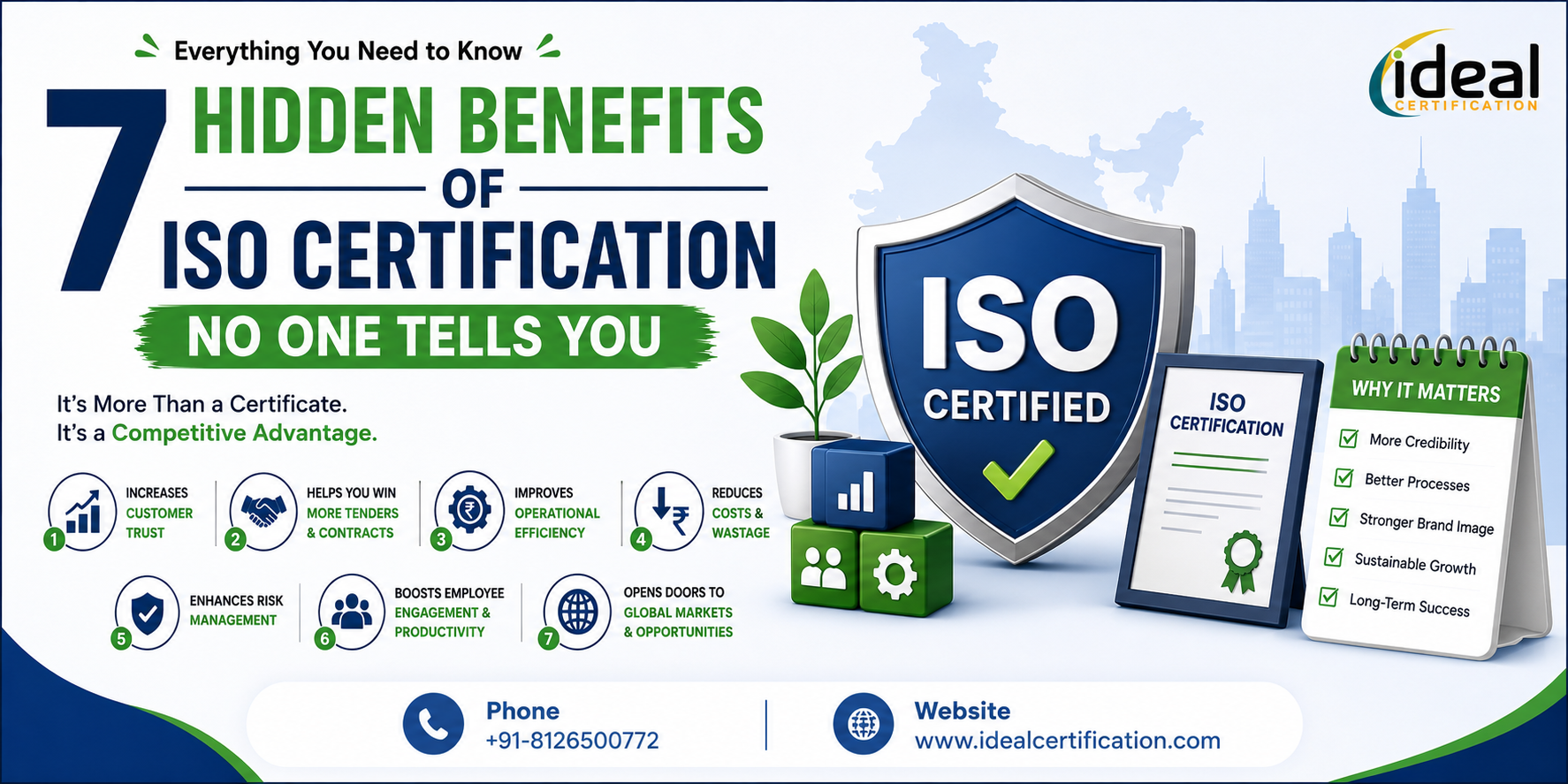
7 Hidden Benefits of ISO Certification No One Tells You
22 Jun 2026
Everyone tells you ISO certification builds trust. Fewer people tell you what it actually does behind the scenes for your business.
If you run a business in India, you've probably heard about ISO certification as a "quality stamp." That's true, but it's only a small part of the story.
The real value of ISO certification shows up in places most business owners never expect — in your bank loan approval, your insurance premium, your hiring process, and even your resale value if you ever sell the company.
In this article, we'll walk through 7 hidden benefits of ISO certification that rarely make it into the standard sales pitch.
What Is ISO Certification, Really?
ISO certification confirms that your business follows internationally recognized standards for quality, safety, or management set by the International Organization for Standardization.
Most Indian businesses pursue ISO 9001 (Quality Management), ISO 14001 (Environmental Management), or ISO 27001 (Information Security). Each standard targets a different operational need, but all of them share one core idea: consistency.
Once certified by an accredited body, your business gets formal proof that your processes meet a global benchmark — not just an internal claim, but a third-party verified one.
1. Easier Access to Business Loans and Funding
Banks and NBFCs in India increasingly favor ISO-certified companies when evaluating loan applications.
A certified quality management system signals lower operational risk to lenders. This can translate into faster loan processing and sometimes better interest rate negotiations, especially for MSMEs applying under government-backed credit schemes.
Investors run the same logic. During due diligence, an ISO certificate is one less red flag they need to chase down.
2. Lower Insurance Premiums
Few business owners realize this: some insurers offer reduced premiums for ISO 27001 (security) or ISO 45001 (workplace safety) certified companies.
Why? Certified businesses statistically file fewer claims. Their risk management systems catch problems before they become costly incidents.
If you're paying for business insurance, cyber liability cover, or workers' compensation, it's worth asking your insurer directly whether certification affects your premium.
3. Stronger Position in Salary and Hiring Negotiations
ISO certification isn't just for customers — it matters to talent too.
Skilled professionals increasingly research a company's certifications before accepting an offer. A certified quality or safety system tells candidates that the workplace has documented processes, not chaotic ad-hoc management.
This becomes a quiet advantage during hiring season, particularly in manufacturing, IT, and export-driven sectors where ISO 9001 and ISO 27001 certification benefits for business reputation directly influence recruitment.
4. Higher Resale and Valuation Value
If you ever plan to sell your business, bring in a partner, or attract acquisition interest, certification adds tangible value to your balance sheet.
Buyers pay a premium for businesses with documented, repeatable processes because it reduces the risk of operational disruption after a leadership change. An ISO-certified company is, in a sense, easier to hand over.
5. Fewer Customer Complaints and Returns
This benefit is rarely discussed because it's not flashy — but it's one of the most financially significant.
ISO 9001 requires structured corrective action processes. Over time, this drastically reduces repeat errors, customer complaints, and product returns.
Less time spent fighting fires means more time spent growing the business. This is one of the most underrated benefits of ISO certification for small business owners specifically, since smaller teams can't afford constant rework.
6. Eligibility for Government Tenders and Subsidies
Many Indian government tenders explicitly require ISO certification as an eligibility criterion. Without it, your business is automatically excluded — regardless of how good your product or pricing is.
Beyond tenders, several state and central MSME schemes offer subsidies specifically for ISO certification costs, making this one of the few certifications that can partially pay for itself.
7. A Built-In Internal Audit System (Free Risk Management)
ISO certification forces your business to conduct regular internal audits. Most companies never build this discipline on their own because it feels like an unnecessary expense.
But this internal audit habit acts as an early warning system. It catches inefficiencies, compliance gaps, and safety risks long before they turn into lawsuits, regulatory fines, or PR disasters.
In effect, you get a built-in risk management consultant — without paying ongoing consultant fees.
Why These Hidden Benefits Matter More in 2026
The Indian ISO certification market is growing at a compound rate of over 16% annually, driven largely by SMEs pursuing export opportunities and digital compliance requirements. As global buyers and Indian regulators tighten scrutiny, the businesses that certify early capture these hidden advantages before competitors catch up.
If your business operates in manufacturing, IT services, exports, food processing, or healthcare, the window to get ahead with certification is now — not after a competitor or regulator forces your hand.
How to Start the ISO Certification Process
- Identify the right standard — ISO 9001, ISO 14001, ISO 27001, or ISO 45001, depending on your industry.
- Choose an accredited certification body — always verify NABCB or IAF accreditation.
- Prepare your documentation — policies, quality manuals, and procedures aligned to the standard.
- Undergo the audit — a certification body auditor reviews your systems on-site or remotely.
- Receive your certificate — and begin annual surveillance audits to stay compliant.
👉 Related reading: ISO 9001 Certification Process Explained | ISO Certification Cost in India | Industries That Need ISO Certification
📚 For more on the standards body itself, visit the official ISO.org website.
Frequently Asked Questions
Q1. What are the hidden benefits of ISO certification? Beyond credibility, ISO certification can improve loan approval chances, reduce insurance premiums, strengthen hiring outcomes, increase business resale value, and unlock government tender eligibility.
Q2. How does ISO certification help small businesses in India? It builds buyer trust, reduces operational errors, and qualifies the business for MSME subsidies and government tenders that require certification as an eligibility condition.
Q3. Is ISO certification mandatory for government tenders in India? It isn't mandatory for every tender, but many central and state government tenders list ISO certification as a required or preferred eligibility criterion.
Q4. How much does ISO certification cost in India? Costs typically range from ₹15,000 to several lakhs depending on the standard, company size, and certification body, with several MSME schemes offering partial subsidy support.
Q5. How long does it take to get ISO certified? Most businesses complete certification within 2 to 6 weeks after documentation is ready, though timelines vary based on company size and audit scheduling.
Get ISO Certified With Confidence
Most of the value of ISO certification happens quietly — in approvals, negotiations, and decisions you never see directly. But it compounds over time, and businesses that certify early capture that advantage first.
If you're ready to explore ISO 9001, ISO 14001, ISO 27001, or any other certification for your business, Ideal Certification can guide you through the entire process — from choosing the right standard to passing your audit with zero guesswork.
📧 Email: info@idealcertification.com 📞 Phone: +91-8126500772 📍 Address: Ground Floor, Shop No.11, EL - Commercia, Pr 7 Road, Near Maya Garden City, Gate No.3, Zirakpur, Punjab - 140603
Get in touch today and turn ISO certification into your next competitive advantage.