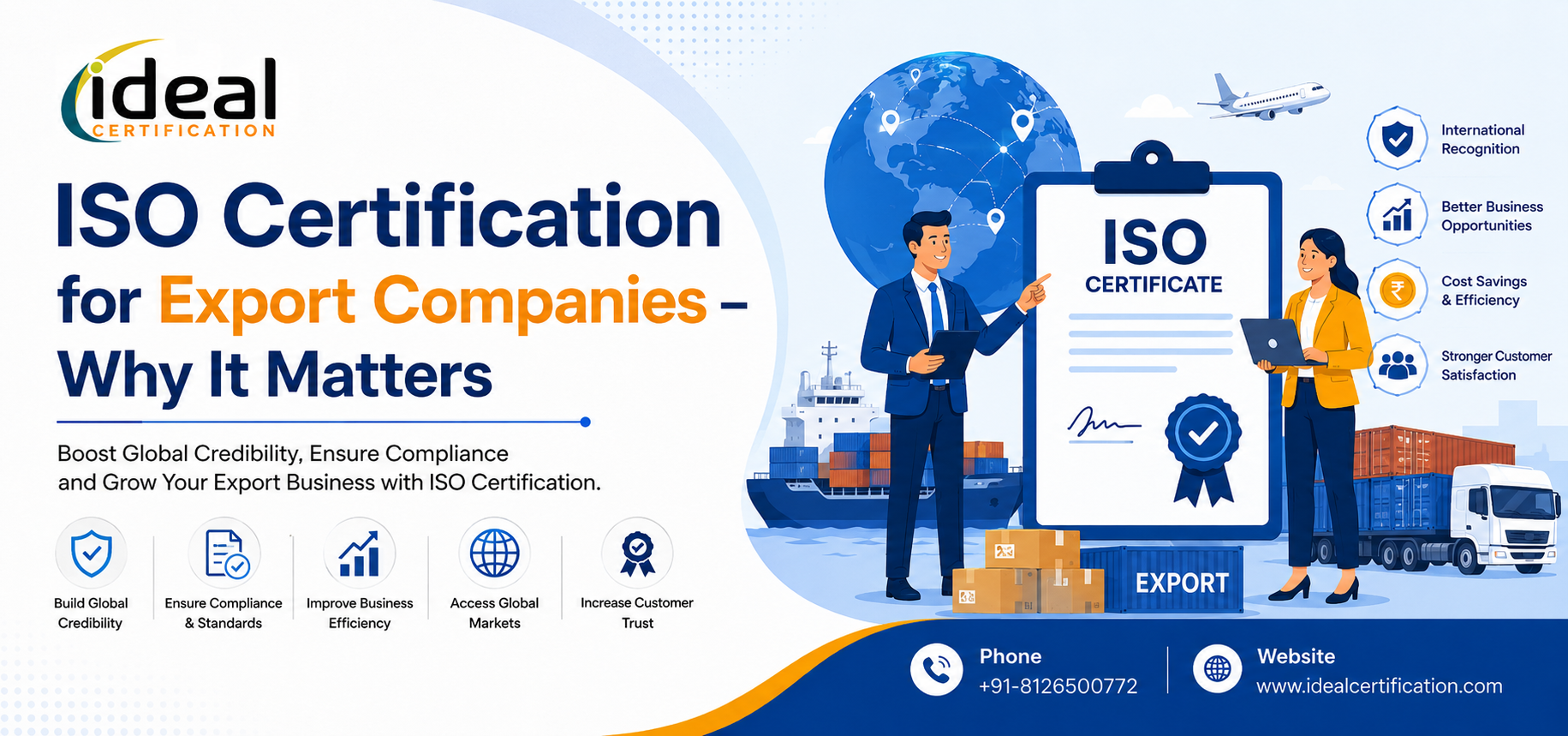
ISO Certification for Export Companies Why It Matters
01 Jun 2026
Introduction
If you're an Indian exporter looking to expand into international markets, one credential can significantly improve your chances of winning global contracts—ISO Certification.
In today's competitive export landscape, international buyers expect suppliers to demonstrate quality, consistency, safety, and compliance with globally accepted standards. ISO certification serves as proof that your business operates according to internationally recognized management systems and best practices.
Whether you export textiles, engineering products, pharmaceuticals, food products, or industrial goods, obtaining ISO certification can open doors to new markets, increase buyer confidence, and strengthen your global reputation.
What Is ISO Certification and Why Do Exporters Need It?
ISO (International Organization for Standardization) is a globally recognized organization that develops standards to ensure quality, efficiency, safety, and consistency across industries.
When an export company obtains ISO certification, it demonstrates to overseas buyers, distributors, and regulatory authorities that its products and processes meet internationally accepted standards.
For Indian exporters, ISO certification is often the difference between securing a contract and losing business to certified competitors in countries such as China, Vietnam, Thailand, and Eastern Europe.
Quick Fact
More than 1.2 million organizations across 170+ countries hold ISO 9001 certification, making it one of the most widely recognized quality standards worldwide.
Why ISO Certification Matters for Export Businesses
International buyers prefer working with suppliers that follow documented and audited management systems. ISO certification helps exporters:
-
Build trust with foreign customers
-
Meet international procurement requirements
-
Improve product quality and consistency
-
Reduce operational errors
-
Enhance brand credibility
-
Gain access to international tenders
-
Improve supply chain efficiency
-
Strengthen long-term business relationships
In many industries, ISO certification is considered a prerequisite for supplier onboarding and vendor approval.
Most Important ISO Standards for Export Companies
1. ISO 9001 – Quality Management System (QMS)
ISO 9001 is the most widely accepted ISO certification for exporters.
It focuses on:
-
Quality control
-
Customer satisfaction
-
Process management
-
Continuous improvement
-
Risk-based thinking
International procurement teams often consider ISO 9001 certification as a minimum requirement before approving a supplier.
Best For:
-
Manufacturing companies
-
Engineering exporters
-
Textile exporters
-
Pharmaceutical exporters
-
Service exporters
2. ISO 14001 – Environmental Management System (EMS)
Environmental sustainability has become a major concern for global buyers, especially in European markets.
ISO 14001 demonstrates that your organization actively manages its environmental impact by:
-
Reducing waste
-
Improving resource efficiency
-
Controlling pollution
-
Meeting environmental regulations
Many European importers now require suppliers to maintain environmental management systems.
Best For:
-
Manufacturing units
-
Chemical exporters
-
Industrial exporters
-
Textile industries
3. ISO 22000 – Food Safety Management System
Food exporters must comply with strict food safety requirements.
ISO 22000 ensures that food products remain safe throughout the supply chain, from production to delivery.
The standard covers:
-
HACCP principles
-
Food safety hazards
-
Risk management
-
Supply chain controls
Best For:
-
Food exporters
-
Spice exporters
-
Beverage manufacturers
-
Agricultural product exporters
4. ISO 45001 – Occupational Health & Safety Management System
Many multinational corporations now assess supplier workplace safety before awarding contracts.
ISO 45001 demonstrates a commitment to:
-
Employee safety
-
Hazard prevention
-
Workplace risk management
-
Legal compliance
A safer workplace also leads to increased productivity and reduced operational disruptions.
Best For:
-
Manufacturing companies
-
Construction-related exporters
-
Engineering industries
-
Industrial facilities
Key Benefits of ISO Certification for Indian Exporters
1. Access to International Markets
ISO certification helps businesses enter:
-
European Union (EU)
-
United States
-
United Kingdom
-
Australia
-
Gulf Countries (UAE, Saudi Arabia, Qatar)
-
ASEAN Markets
Many importers require certified suppliers before initiating business relationships.
2. Increased Buyer Confidence
International buyers are more likely to trust suppliers that have been independently audited and certified.
This trust often results in:
-
Faster approvals
-
Larger purchase orders
-
Long-term contracts
-
Better payment terms
3. Competitive Advantage
When multiple suppliers offer similar products, ISO certification often becomes the deciding factor.
Certified exporters stand out from non-certified competitors and gain a significant advantage during vendor evaluations.
4. Improved Internal Efficiency
ISO implementation improves:
-
Documentation
-
Process consistency
-
Resource utilization
-
Employee accountability
-
Operational performance
This leads to reduced costs and improved profitability.
5. Government Support and Incentives
Several export promotion schemes and MSME support programs encourage ISO-certified businesses.
Certain sectors may also receive partial reimbursement for certification expenses through government initiatives.
6. Reduced Buyer Audits
Many international customers reduce the frequency of supplier audits when valid ISO certification is maintained.
This saves time, resources, and operational disruptions.
Is ISO Certification Mandatory for Exporting from India?
Legally, ISO certification is not mandatory for every export business in India.
However, from a practical business perspective, ISO certification has become essential for companies aiming to compete internationally.
Many foreign buyers require suppliers to maintain certified management systems before approving contracts, especially in:
-
Food exports
-
Pharmaceuticals
-
Engineering products
-
Manufacturing
-
Consumer goods
Therefore, while not legally compulsory, ISO certification is often a business necessity.
How to Get ISO Certified for Your Export Business
Step 1: Select the Appropriate ISO Standard
Choose the certification that best aligns with your products, industry, and target export markets.
Step 2: Conduct a Gap Analysis
Evaluate current business processes against ISO requirements to identify areas needing improvement.
Step 3: Implement the Management System
Develop:
-
Standard Operating Procedures (SOPs)
-
Quality manuals
-
Process controls
-
Employee training programs
Step 4: Perform an Internal Audit
Verify compliance before undergoing external certification audits.
Step 5: Certification Audit
An accredited certification body conducts:
-
Stage 1 Audit (Documentation Review)
-
Stage 2 Audit (Implementation Assessment)
Step 6: Receive Certification
After successful completion of audits, the ISO certificate is issued.
Certification remains valid for three years, subject to annual surveillance audits.
How Long Does ISO Certification Take?
The certification timeline depends on:
-
Business size
-
Operational complexity
-
Existing management systems
-
Chosen ISO standard
For most small and medium-sized export companies, certification can typically be achieved within 4–8 weeks.
Organizations with well-established processes may complete certification even faster.
Choosing the Right ISO Certification Consultant
The credibility of your certification depends heavily on the certification body and consultant you choose.
Before proceeding, ensure:
-
The certification body is NABCB-accredited
-
The consultant has relevant industry experience
-
Documentation support is provided
-
Post-certification guidance is available
-
The process remains transparent and compliant
Working with experienced professionals ensures faster implementation and globally accepted certification.
Frequently Asked Questions (FAQs)
Q1. Is ISO certification mandatory for export companies in India?
No, ISO certification is not legally mandatory. However, many international buyers require certified suppliers, making it highly beneficial for export businesses.
Q2. Which ISO certification is best for an export company?
ISO 9001 is the most commonly required certification. Food exporters may require ISO 22000, while environmentally focused markets often prefer ISO 14001 certification.
Q3. How much does ISO certification cost for exporters in India?
The cost generally ranges between ₹15,000 and ₹60,000 depending on business size, certification scope, and chosen standard.
Q4. How long is an ISO certificate valid?
ISO certificates are valid for three years, with annual surveillance audits conducted during the validity period.
Q5. Can MSMEs and small exporters obtain ISO certification?
Yes. ISO standards are designed for organizations of all sizes, including startups, MSMEs, and small export businesses.
Conclusion
In today's global marketplace, ISO certification is far more than a compliance requirement—it is a strategic business investment.
Whether you export food products, textiles, pharmaceuticals, engineering goods, or industrial products, ISO certification enhances credibility, improves operational efficiency, and increases your chances of winning international contracts.
The cost of certification is relatively small compared to the long-term benefits it delivers in terms of buyer trust, market access, and sustainable growth.
For Indian exporters aiming to compete on a global stage, ISO certification is one of the smartest investments they can make.
Ready to Get ISO Certified for Your Export Business?
Ideal Certification helps exporters across India achieve internationally recognized ISO certification quickly, affordably, and professionally.
Contact Us
📧 Email: info@idealcertification.com
📞 Phone: +91-8126500772
📍 Address: Shop No.11, EL-Commercia, PR 7 Road, Near Maya Garden City, Gate No.3, Zirakpur, Punjab – 140603
🌐 Website: www.idealcertification.com
Get a Free Consultation Today and take your export business to global markets with confidence.