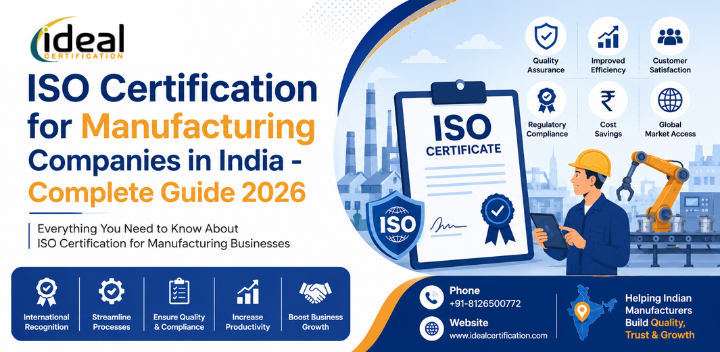
ISO Certification for Manufacturing Companies in India
23 May 2026
If you run a manufacturing business in India, ISO certification is no longer optional — it is a competitive necessity. Whether you are exporting goods, bidding on government tenders, or scaling your operations, an ISO-certified manufacturing company signals quality, compliance, and global credibility.
This comprehensive guide covers everything you need to know about ISO certification for manufacturing companies in India — including which standards apply to your industry, step-by-step certification process, costs, timelines, and how Ideal Certification helps you get certified faster.
What Is ISO Certification and Why Does It Matter for Indian Manufacturers?
ISO (International Organization for Standardization) develops internationally recognized standards that define quality, safety, environmental, and operational benchmarks across industries.
For Indian manufacturers, ISO certification serves multiple critical purposes:
- Demonstrates product and process quality to domestic and international buyers
- Qualifies your business for government tenders and procurement
- Meets buyer requirements for export to the USA, EU, and Middle East
- Builds customer trust and strengthens your brand authority
- Reduces waste, defects, and operational costs through structured quality management
- Supports Make in India initiative alignment and regulatory compliance
Simply put, ISO certification is the quality stamp that opens doors — and in Indian manufacturing, those doors lead to bigger contracts, better margins, and lasting growth.
Which ISO Certifications Are Most Important for Manufacturing Companies in India?
Not every ISO standard applies to every business. Here are the most critical ISO standards for Indian manufacturers:
1. ISO 9001 — Quality Management System (QMS)
ISO 9001 is the world's most widely adopted ISO standard and the foundation of quality management for any manufacturing company. It ensures consistent product quality, process control, and customer satisfaction.
- Applicable to all manufacturing sectors
- Required for most government tenders and supply chains
- Foundation for all other ISO certifications
2. ISO 14001 — Environmental Management System
ISO 14001 certification demonstrates your commitment to environmental compliance. It is increasingly required by international buyers and large corporates looking for sustainable supply chain partners.
3. ISO 45001 — Occupational Health and Safety
This standard covers workplace safety management — essential for manufacturing plants where hazards are common. ISO 45001 helps reduce accidents, legal liabilities, and workforce downtime.
4. IATF 16949 — Automotive Manufacturing
If you are an automotive component manufacturer in India, IATF 16949 is a mandatory requirement from OEMs like Tata, Maruti, Hyundai, and global clients. It integrates ISO 9001 with automotive-specific quality requirements.
5. ISO 13485 — Medical Device Manufacturers
For medical device and equipment manufacturing companies in India, ISO 13485 is essential for regulatory approvals and hospital supply contracts.
6. AS9100 — Aerospace Manufacturing
Indian aerospace component manufacturers seeking global supply chain integration need AS9100 certification, which adds aviation-specific requirements on top of ISO 9001.
ISO Certification Process: Step-by-Step for Manufacturing Companies in India
The ISO certification process may seem complex, but with the right consultant by your side, it becomes straightforward. Here is what the journey looks like:
Step 1: Gap Analysis
Your certification consultant conducts a thorough gap analysis of your existing processes against the chosen ISO standard requirements. This identifies areas that need attention before certification.
Step 2: Documentation & QMS Development
Prepare required documentation including quality policy, procedures, work instructions, and records. For ISO 9001, this means building a complete Quality Management System (QMS) tailored to your manufacturing environment.
Step 3: Implementation
Roll out the QMS across your manufacturing plant. Train your team on new processes, responsibilities, and documentation requirements.
Step 4: Internal Audit
Conduct an internal audit to verify your systems are working correctly and that all ISO requirements are being met.
Step 5: Management Review
Senior management reviews the audit findings and system performance to confirm readiness for external certification.
Step 6: Stage 1 Audit (Document Review)
An accredited certification body conducts a document review audit to check if your documentation and systems meet ISO requirements in principle.
Step 7: Stage 2 Audit (Certification Audit)
This is the on-site audit where the certification body verifies actual implementation of your QMS across the manufacturing plant.
Step 8: ISO Certificate Issued
Upon successful completion, you receive your ISO certificate — valid for three years, subject to annual surveillance audits.
ISO Certification Cost for Manufacturing Companies in India
One of the most common questions we receive is: "How much does ISO certification cost for a manufacturing company in India?"
The honest answer is — it depends on several factors:
- Size of your manufacturing unit (number of employees, locations)
- Complexity of manufacturing processes
- Which ISO standard you are applying for
- Current state of your documentation and systems
- The certification body you choose
For small to medium manufacturing units in India, ISO 9001 certification typically costs between INR 25,000 to INR 80,000 all-inclusive, covering consultation, documentation, audit, and certificate fees.
At Ideal Certification, we offer transparent, competitive ISO certification packages for MSME and large manufacturing companies with no hidden charges. Contact us for a customized quote.
How Long Does ISO Certification Take for Manufacturers in India?
The timeline for ISO certification depends on your company's preparedness and the ISO standard being targeted. On average:
- ISO 9001 for a small manufacturer: 4 to 8 weeks
- ISO 14001 or ISO 45001 alongside ISO 9001: 6 to 12 weeks
- IATF 16949 for automotive manufacturers: 3 to 6 months
- ISO 13485 for medical device manufacturers: 3 to 5 months
With expert guidance from Ideal Certification's consultants, many small and medium manufacturing companies in India complete the entire ISO 9001 certification process in as little as 30 to 45 days.
Key Benefits of ISO Certification for Manufacturing Companies in India
The return on investment from ISO certification is significant and measurable. Here is what certified manufacturers report:
- Win more government tenders — ISO certification is often mandatory for MSME, PSU, and defence procurement
- Export readiness — ISO certified status is recognized globally in 170+ countries
- Reduced product defects and rework costs through structured process control
- Improved employee productivity and accountability
- Easier bank loans and MSME credit access as a certified business
- Stronger positioning against competitors in B2B sales and RFPs
- Better supplier and buyer relationships built on verified quality systems
Is ISO Certification Mandatory for Manufacturers in India?
ISO certification is not legally mandatory in India — but it is practically essential. Here is why:
- Government e-procurement portals like GeM often require ISO-certified suppliers
- PSUs (BHEL, NTPC, ONGC, etc.) mandate ISO 9001 for vendor registration
- Export buyers in the USA, EU, and Middle East require ISO as a baseline quality proof
- Major Indian corporations require ISO certification in their supplier qualification processes
For MSME manufacturers in India, the government also provides partial subsidies on ISO certification costs under various state and central schemes — making this investment even more accessible.
Documents Required for ISO Certification in India
Here is a quick checklist of documents typically required for ISO 9001 certification for a manufacturing company:
- Company registration certificate and GST registration
- Business address proof and plant/factory layout
- Existing quality or process documentation
- Product/service list and scope of operations
- Organizational chart and key personnel details
- List of key customers and major suppliers
- Any existing certifications (BIS, BIS CRS, CE, etc.)
Our team at Ideal Certification assists you in preparing every document — so you never face certification delays due to paperwork issues.
Why Choose Ideal Certification for ISO Certification in India?
Ideal Certification is a trusted name in ISO consulting and certification services across India. Here is what sets us apart:
- End-to-end certification support — from gap analysis to certificate issuance
- Experienced consultants with deep manufacturing sector expertise
- Accredited certification bodies — globally recognized ISO certificates
- Affordable, transparent pricing — no hidden fees
- Fast-track certification options available
- Post-certification surveillance audit support
- Serving MSME, SME, and large manufacturing companies across India
Frequently Asked Questions (FAQ)
Q1. Which ISO certification is best for manufacturing companies in India?
ISO 9001 is the most important and widely applicable ISO certification for manufacturing companies in India. It establishes a quality management system that applies across all industries. Depending on your sector, you may also need ISO 14001 (environment), ISO 45001 (safety), IATF 16949 (automotive), or ISO 13485 (medical devices).
Q2. How much does ISO certification cost for a manufacturing company in India?
ISO certification cost for manufacturing companies in India ranges from INR 25,000 to INR 1,00,000 depending on company size, number of processes, chosen ISO standard, and the certification body. Ideal Certification offers affordable packages with transparent pricing and no hidden charges.
Q3. How long does it take to get ISO certified in India?
For small to medium manufacturing units, ISO 9001 certification typically takes 4 to 8 weeks. With Ideal Certification's expert consultants, many clients complete the process in 30 to 45 days. More complex standards like IATF 16949 may take 3 to 6 months.
Q4. Is ISO certification mandatory for manufacturers in India?
ISO certification is not legally mandatory in India, but it is practically required for government tender participation, GeM portal registration, PSU vendor approval, and export to international markets. Many large Indian corporations also require ISO certification for supplier qualification.
Q5. Can a small manufacturing business get ISO certified in India?
Yes, absolutely. ISO certification is available for businesses of all sizes, including small manufacturing units and MSMEs. The government also provides ISO certification subsidies for MSMEs under various central and state schemes. Ideal Certification specializes in helping small manufacturers get ISO certified affordably and quickly.
Conclusion
ISO certification for manufacturing companies in India is not just a quality badge — it is a strategic business asset. It opens doors to government contracts, international exports, and premium domestic buyers while simultaneously driving down your operational costs and defect rates.
Whether you are a small MSME manufacturer in Gujarat or a large industrial unit in Pune, the right ISO certification elevates your business credibility and competitive edge in today's demanding market.
The process is simpler than you think — especially when guided by experienced ISO certification consultants who understand Indian manufacturing
Ready to Get ISO Certified?
Talk to our ISO experts today — free consultation, no obligation.
Email: info@idealcertification.com
Phone / WhatsApp: +91-8126500772
Ground Floor, Shop No. 11, EL-Commercia, PR 7 Road,
Near Maya Garden City, Gate No.3, Zirakpur, Punjab — 140603
www.idealcertification.com