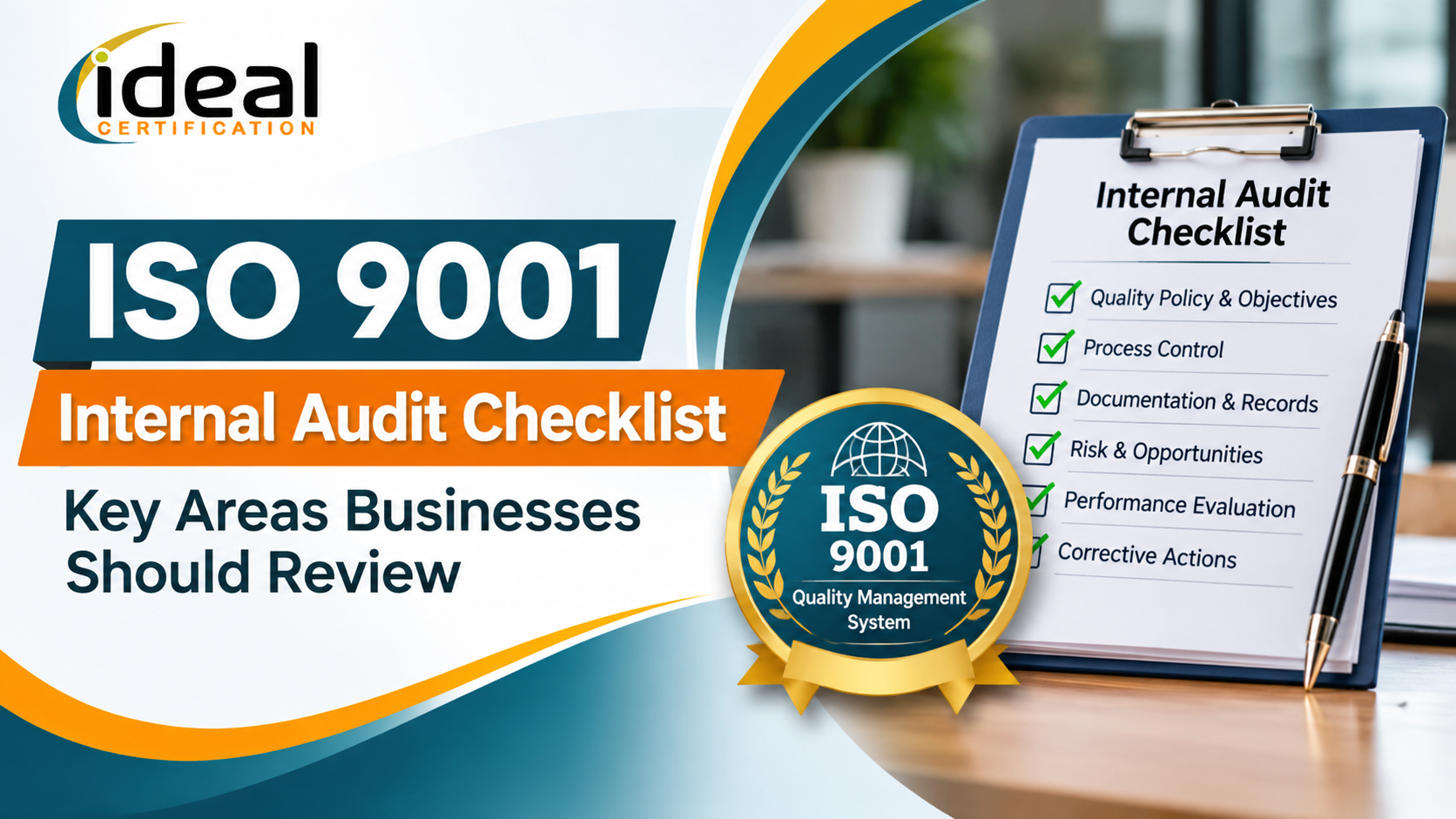
ISO 9001 Internal Audit Checklist
05 Oct 2026
An effective quality management system helps a business maintain consistent product and service quality, meet customer expectations, and improve its internal processes. However, simply documenting procedures is not enough. Organizations must also check whether their quality management system works as intended.
An ISO 9001 internal audit checklist helps businesses review their processes, identify gaps, verify compliance, and prepare for external certification or surveillance audits. It provides a structured way to examine records, employee practices, operational controls, and improvement activities.
For Indian manufacturers, service providers, MSMEs, and growing companies, a well-planned internal audit can reveal problems before they affect customers or business performance.
This guide explains the key areas to review, the documents to prepare, and the steps involved in conducting an effective ISO 9001 internal audit.
Important edition note: ISO 9001:2026 was published on 16 September 2026, replacing ISO 9001:2015 as the current edition. This guide uses familiar ISO 9001:2015 clause references to explain the established audit framework. Organizations should check the applicable edition and transition arrangements with their certification body and update their audit criteria accordingly.
What Is an ISO 9001 Internal Audit Checklist?
An ISO 9001 internal audit checklist is a structured list of questions and verification points used to evaluate whether an organization's quality management system meets the applicable ISO 9001 requirements and its own documented processes.
The checklist helps internal auditors determine whether processes are implemented, maintained, and effective. It also supports consistent audit planning, evidence collection, reporting, and corrective action.
A typical QMS internal audit checklist covers:
- Quality policy and objectives
- Leadership responsibilities
- Risk assessment and planning
- Employee competence and training
- Documented information and records
- Operational controls
- Supplier evaluation
- Customer satisfaction and complaints
- Monitoring and measurement
- Nonconformities and corrective actions
- Management review and continual improvement
The checklist should reflect the organization's activities, risks, size, and QMS scope rather than relying on a generic template alone.
Why Is an ISO 9001 Internal Audit Important?
Internal auditing is an important part of maintaining an effective quality management system. It helps management understand whether documented procedures match actual workplace practices.
Key benefits include:
- Early identification of problems: Find process gaps before they cause repeated defects or customer complaints.
- Better documentation control: Verify that employees use current procedures, forms, and work instructions.
- Improved operational consistency: Check whether departments follow approved processes.
- Stronger corrective actions: Identify the causes of problems and verify that corrective actions work.
- Audit readiness: Prepare evidence and records for external certification and surveillance audits.
- Continual improvement: Use audit findings to improve efficiency and quality performance.
An internal audit is not simply a document-checking exercise. It should evaluate actual implementation and the effectiveness of the quality management system.
ISO 9001 Internal Audit Checklist: Key Areas to Review
The following checklist follows the familiar ISO 9001:2015 requirements structure. Confirm the applicable edition before using it as a formal audit tool.
1. Context of the Organization — Clause 4
Review whether the organization understands its business environment, relevant interested parties, and QMS scope.
Checklist questions:
- Has the organization identified relevant internal and external issues?
- Are customer and regulatory requirements understood?
- Is the QMS scope documented and appropriate?
- Are key processes and their interactions identified?
Evidence to review: QMS scope, process maps, business context records, and relevant stakeholder requirements.
2. Leadership and Responsibilities — Clause 5
Leadership must support the quality management system and promote customer focus.
Checklist questions:
- Is the quality policy communicated and understood?
- Are responsibilities and authorities clearly assigned?
- Does management demonstrate commitment to quality?
- Are customer requirements considered in business decisions?
Evidence to review: Quality policy, organizational charts, assigned responsibilities, and management communications.
3. Planning and Risk Management — Clause 6
Check how the business addresses risks, opportunities, quality objectives, and planned changes.
Checklist questions:
- Have relevant risks and opportunities been identified?
- Are measurable quality objectives established where appropriate?
- Are responsibilities and timelines assigned to objectives?
- Are planned changes reviewed before implementation?
Evidence to review: Risk assessments, quality objectives, action plans, and change records.
4. Support and Resources — Clause 7
Verify that the organization has the resources, competence, communication, and documented information needed to operate its QMS.
Checklist questions:
- Are employees competent for their assigned roles?
- Are training needs identified and evaluated?
- Are measuring instruments controlled and calibrated where required?
- Are documents approved, updated, and accessible?
- Are relevant records protected and retained?
Evidence to review: Training records, competence evaluations, calibration records, document registers, and controlled work instructions.
5. Operation and Process Control — Clause 8
Operational controls are particularly important for manufacturing companies and service-based businesses.
Checklist questions:
- Are customer requirements reviewed before commitments are made?
- Are production or service activities carried out under controlled conditions?
- Are suppliers evaluated using appropriate criteria?
- Are inspections and acceptance checks completed where required?
- Are nonconforming outputs identified and controlled?
Evidence to review: Purchase records, supplier evaluations, inspection reports, work orders, service records, and nonconformity logs.
6. Performance Evaluation — Clause 9
The organization must monitor its quality management system and evaluate its performance.
Checklist questions:
- Are suitable quality performance indicators monitored?
- Is customer satisfaction evaluated?
- Are internal audits conducted at planned intervals?
- Are audit results reported to relevant management?
- Are management reviews completed and recorded?
Evidence to review: KPI reports, customer feedback, audit schedules, previous audit reports, and management review minutes.
7. Improvement — Clause 10
Check whether the organization responds effectively to problems and works to improve its QMS.
Checklist questions:
- Are nonconformities recorded and addressed?
- Are root causes investigated where appropriate?
- Are corrective actions implemented?
- Is the effectiveness of corrective action verified?
- Are opportunities for continual improvement evaluated?
Evidence to review: Corrective action reports, root cause analysis, improvement plans, and follow-up audit records.
Documents Required for an ISO 9001 Internal Audit
The records required will depend on the organization's scope, processes, risks, and applicable requirements.
Common documents and records include:
- QMS scope and process information
- Quality policy and objectives
- Risk and opportunity records
- Training and competence records
- Document control records
- Supplier evaluation records
- Customer complaint and feedback records
- Inspection and monitoring results
- Equipment calibration records, where applicable
- Internal audit programme and previous reports
- Nonconformity and corrective action records
- Management review records
Auditors should verify both the availability of records and whether they provide reliable evidence of effective implementation.
How to Conduct an ISO 9001 Internal Audit Step by Step
A structured ISO 9001 internal audit procedure makes the process more consistent and useful.
Step 1: Plan the audit. Define the audit scope, criteria, objectives, departments, and schedule. Consider process importance, organizational changes, and previous audit results.
Step 2: Prepare the checklist. Develop questions based on the applicable standard, internal procedures, and actual business processes.
Step 3: Assign a competent auditor. Auditors should understand the relevant requirements and perform their work objectively. Where practical, avoid assigning auditors to assess their own work.
Step 4: Collect evidence. Interview employees, examine records, observe operations, and sample relevant activities.
Step 5: Record findings. Document objective evidence and distinguish conformities, nonconformities, and improvement opportunities.
Step 6: Prepare the audit report. Summarize the scope, criteria, findings, and conclusions, then communicate results to the appropriate managers.
Step 7: Follow up. Ensure necessary corrective actions are taken and their effectiveness is verified.
ISO 9001 requires internal audits at planned intervals. The audit programme should consider process importance, changes affecting the organization, and previous audit results.
Common ISO 9001 Internal Audit Nonconformities
Common findings may include:
- Employees using outdated work instructions
- Incomplete training or competence records
- Missing inspection or monitoring evidence
- Supplier evaluations not performed as planned
- Customer complaints not properly investigated
- Corrective actions closed without effectiveness checks
- Quality objectives not monitored
- Internal audits not completed according to the programme
A finding should be based on a clear requirement and objective evidence. Auditors should avoid treating personal preferences as nonconformities.
Five Frequently Asked Questions
1. What is an ISO 9001 internal audit checklist?
It is a structured set of questions used to evaluate whether a quality management system meets applicable ISO 9001 requirements and the organization's own processes.
2. Is an ISO 9001 internal audit mandatory?
Yes. For organizations claiming conformity to ISO 9001, internal audits are required by the standard. They must be conducted at planned intervals according to the applicable requirements.
3. How often should an ISO 9001 internal audit be conducted?
The organization determines its audit frequency based on process importance, changes, risks, and previous audit results. A single fixed frequency is not appropriate for every business.
4. What documents are required for an ISO 9001 internal audit?
Common records include the audit programme, QMS scope, quality objectives, training records, supplier evaluations, operational records, previous audit reports, and corrective action documentation. The exact list depends on the organization's processes.
5. Who can conduct an ISO 9001 internal audit?
A competent person who can evaluate the relevant requirements objectively may conduct an internal audit. The organization should ensure suitable auditor competence and impartiality, including avoiding audits of one's own work where practical.
Conclusion: Prepare Your Business for an Effective ISO 9001 Audit
A well-prepared ISO 9001 internal audit checklist helps organizations evaluate their processes, identify nonconformities, improve documentation, and maintain an effective quality management system.
For the best results, tailor the checklist to your business activities, collect objective evidence, document findings clearly, and verify corrective actions. Also ensure that your audit criteria reflect the applicable edition of ISO 9001.
If your organization needs assistance with ISO 9001 documentation, QMS implementation, audit preparation, or certification-related guidance, Ideal Certification can help you understand the next steps.
Contact Ideal Certification
- Email: info@idealcertification.com
- Phone: +91-8126500772
- Address: Ground Floor, Shop No.11, EL - Commercia, PR 7 Road, Near Maya Garden City, Gate No.3, Zirakpur, Punjab - 140603
- Website: https://idealcertification.com/
Contact the team to discuss your organization's quality management requirements and plan your next steps toward effective ISO compliance.