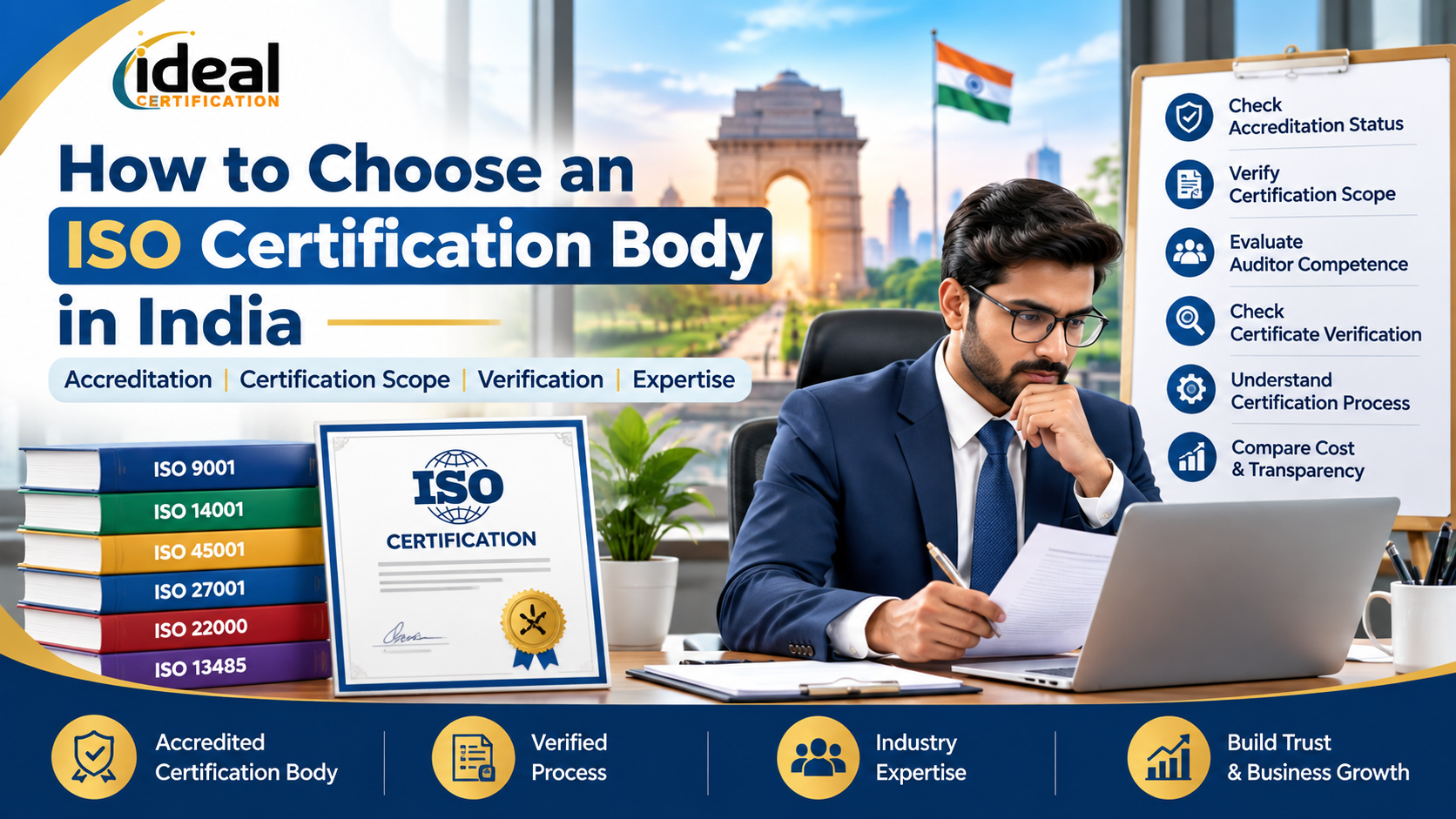
How to Choose an ISO Certification Body in India
01 Sep 2026
Choosing the right ISO certification body in India is an important decision for businesses seeking ISO 9001, ISO 14001, ISO 45001, ISO 27001, ISO 22000, ISO 13485 and other management-system certifications.
The certification body you select can affect the credibility, scope, acceptance and verification of your ISO certificate. For this reason, businesses should not choose a provider only because it offers the lowest price or fastest certificate.
A proper selection process should consider accreditation, certification scope, auditor competence, industry experience, audit methodology, certificate verification, transparency and the organization's actual business requirements.
ISO itself does not issue ISO certificates. Certification is performed by independent certification bodies, while accreditation provides independent confirmation of a certification body's competence. ISO recommends that organizations evaluate certification bodies and check accreditation where relevant.
What Is an ISO Certification Body?
An ISO certification body is an independent organization that assesses whether an organization's management system conforms to the requirements of a particular ISO standard.
Depending on the business and its objectives, certification may relate to standards such as:
- ISO 9001 – Quality Management System
- ISO 14001 – Environmental Management System
- ISO 45001 – Occupational Health & Safety Management System
- ISO 27001 – Information Security Management System
- ISO 22000 – Food Safety Management System
- ISO 13485 – Medical Devices Quality Management System
- ISO 21001 – Educational Organizations Management System
- Other applicable management-system standards
NABCB's current management-system certification directory includes accredited certification bodies across areas such as QMS, EMS, FSMS, ISMS, OHSMS, IT service management, business continuity and other management systems.
The certification body assesses the organization's defined certification scope and, when the applicable requirements have been met, makes the certification decision and issues the certificate.
Certification Body vs ISO Consultant
This distinction is important.
An ISO consultant generally helps a business understand requirements, perform gap analysis, prepare documentation, implement processes and prepare for an audit.
A certification body performs the independent conformity assessment and certification activity.
Therefore, a consultant should not be confused with the independent organization responsible for the certification decision.
How to Choose an ISO Certification Body in India
There is no universal certification body that is automatically suitable for every organization. The appropriate choice depends on your ISO standard, industry, certification scope, customer requirements and whether accredited certification is required.
Here are the most important factors to evaluate.
1. Check Whether the Certification Body Is Accredited
One of the first questions should be:
Is the certification body accredited for the certification service I need?
ISO explains that accreditation provides independent confirmation of competence. However, ISO also states that accreditation is not compulsory in every circumstance and that non-accreditation alone does not necessarily mean a certification body is not reputable.
The important point is to match the certification arrangement to your actual requirement.
Accreditation can be particularly important when certification is required for:
- Government or public-sector procurement
- Customer qualification
- Supplier approval
- Export or international business requirements
- Corporate vendor onboarding
- Contracts specifying accredited certification
- Industry-specific procurement conditions
In India, businesses can consult NABCB's published information on accredited management-system certification bodies.
2. Verify the Accreditation Scope
Simply seeing the word "accredited" on a website is not enough.
You should verify whether the certification body's accreditation covers the specific certification standard and activity relevant to your organization.
For example, if you require ISO 9001 certification, check the certification body's accreditation for the applicable quality-management certification scheme.
Important details include:
- Accreditation body
- Accreditation certificate/reference
- ISO standard covered
- Certification scheme
- Relevant technical or industry scope
- Current accreditation status
- Certification body's legal identity
This is one of the most important steps when selecting an accredited ISO certification body in India.
3. Check the Certification Body's Industry Experience
Industry experience can make an ISO audit more meaningful because different businesses have different processes, risks and operational controls.
For example:
Manufacturing businesses
May require attention to:
- Production controls
- Inspection and testing
- Supplier management
- Traceability
- Product quality
- Nonconforming outputs
IT and software companies
May require consideration of:
- Information security
- Access control
- Asset management
- Risk assessment
- Incident management
- Business continuity
Food businesses
May need systems covering:
- Food-safety hazards
- HACCP principles
- Prerequisite programmes
- Traceability
- Supplier controls
- Food-safety monitoring
Construction and industrial businesses
May require greater focus on:
- Occupational hazards
- Risk assessment
- Contractor controls
- Emergency preparedness
- Workplace safety
Therefore, when comparing ISO certification companies in India, ask whether the certification body has experience with organizations similar to yours.
4. Understand the ISO Certification Process
A reliable certification provider should explain the certification process clearly before you commit.
A typical management-system certification process may include:
- Application and certification scope review
- Audit programme planning
- Stage 1 or readiness assessment, where applicable
- Stage 2 certification audit
- Identification of nonconformities, if applicable
- Corrective-action review
- Certification decision
- Certificate issuance
- Surveillance activities
- Recertification at the end of the certification cycle
The exact process and audit arrangements depend on the applicable standard, certification scheme, organization size, scope and certification-body procedures.
Avoid providers who cannot clearly explain what their quotation includes.
5. Check the Certification Scope Carefully
The ISO certification scope defines what activities, products, services, locations or organizational functions are covered by the certificate.
This is important because an ISO certificate should accurately represent what has actually been assessed.
Before certification, verify:
- Correct legal organization name
- Correct business address
- Applicable locations
- Products or services
- Business activities
- ISO standard
- Certification scope
- Certificate number
- Issue date
- Validity status
A certificate should not be used to imply certification of activities that fall outside its defined scope.
6. Evaluate Auditor Competence and Impartiality
The quality of an ISO certification audit depends partly on the competence and suitability of the audit team.
Before selecting a certification body, ask:
- Does the auditor understand our industry?
- Does the audit team have relevant technical competence?
- How is audit duration determined?
- How are audit findings documented?
- How are nonconformities handled?
- How does the certification body maintain impartiality?
- What happens after the audit?
These questions are particularly useful for organizations with technically complex operations.
The objective should be a meaningful conformity assessment rather than simply obtaining a document.
7. Compare ISO Certification Costs Carefully
ISO certification cost in India varies according to factors such as:
- ISO standard
- Organization size
- Number of employees
- Number of locations
- Business complexity
- Certification scope
- Audit duration
- Certification-body fees
- Travel or assessment expenses
- Consultancy requirements
A very low quotation may not necessarily represent the complete cost.
When comparing ISO certification providers, ask for a clear breakdown covering:
- Application fees
- Audit fees
- Certification fees
- Certificate issuance
- Surveillance arrangements
- Travel expenses, if applicable
- Additional assessment charges
- Consultancy/documentation support, if separately charged
The goal should be transparent pricing and an appropriate certification process, rather than simply choosing the cheapest quotation.
8. Check Certificate Verification Options
Certificate verification is an important part of due diligence.
For an accredited certification, ISO identifies IAF CertSearch as a global database that aggregates information from accreditation bodies and certification bodies, allowing certification and accreditation status to be checked.
You should also check information directly from the relevant certification body and accreditation body where appropriate.
Verify details such as:
- Certificate number
- Organization name
- Certification standard
- Certification scope
- Certification body
- Accreditation information
- Issue date
- Expiry date
- Current certification status
Importantly, failure to find a certificate in one online database should not automatically be interpreted as proof that the certificate is fraudulent. Verification should consider the certification body, relevant accreditation body and database coverage.
9. Check Whether the Certification Body Meets Your Business Requirement
Different businesses pursue ISO certification for different reasons.
Your objective could be:
- Government tender participation
- GeM procurement requirements
- Customer qualification
- Supplier approval
- Export business
- Corporate contracts
- Process improvement
- Information-security requirements
- Food-safety management
- Environmental objectives
- Occupational health and safety
- Medical-device quality management
Therefore, before choosing an ISO certification body, clearly define why you need certification.
For example, if a tender specifically requires accredited ISO 9001 certification, verify the tender's exact wording and ensure that the selected certification arrangement satisfies that requirement.
Which ISO Certification Is Right for Your Business?
The certification body should not be selected before identifying the appropriate standard.
ISO 9001 – Quality Management
Suitable for organizations seeking a structured Quality Management System (QMS) covering areas such as customer requirements, process control, risk-based thinking and continual improvement.
ISO 14001 – Environmental Management
Focuses on environmental management and the organization's environmental aspects and impacts.
ISO 45001 – Occupational Health & Safety
Helps organizations establish a systematic approach to occupational health and safety risks and controls.
ISO 27001 – Information Security
Relevant to organizations managing information-security risks, including IT companies, SaaS businesses, data-driven organizations and other businesses handling sensitive information.
ISO 22000 – Food Safety
Designed for organizations within the food chain, including food manufacturers, processors and other applicable food-related businesses.
ISO 13485 – Medical Devices
Addresses quality-management requirements relevant to organizations involved in medical devices.
Ideal Certification currently provides support across major standards including ISO 9001, ISO 14001, ISO 45001, ISO 27001, ISO 22000 and ISO 13485, along with services such as HACCP, GMP and CE-related certification support.
What Services Should an ISO Certification Consultant Provide?
For organizations that need implementation assistance, a professional consultancy can provide support before the independent certification assessment.
Depending on the standard and business requirements, consultancy support may include:
- Initial consultation
- Standard selection
- Gap analysis
- Documentation guidance
- Policy and procedure development
- Risk assessment
- Process implementation guidance
- Employee awareness/training
- Internal audit preparation
- Management review preparation
- Corrective-action guidance
- External audit preparation
- Certification coordination
- Post-certification support
Ideal Certification describes its service approach as end-to-end support, including documentation, gap analysis, implementation guidance, audit preparation and certification assistance.
Red Flags to Watch for When Choosing an ISO Certification Provider
Businesses should be cautious if a provider:
- Guarantees a certificate without an appropriate assessment
- Refuses to explain who will issue the certificate
- Cannot provide accreditation information when accredited certification is required
- Uses vague claims about "ISO approval"
- Does not clearly define the certification scope
- Provides an unexplained all-inclusive quotation
- Cannot explain certificate verification
- Confuses consultancy with certification
- Makes unrealistic promises about universal acceptance
- Uses the ISO name or logo in a misleading certification claim
ISO specifically states that ISO does not perform certification or issue certificates. Organizations seeking certification must work with independent certification bodies. ISO also states that the ISO logo should not be used in connection with certification.
Questions to Ask Before Choosing an ISO Certification Body
Before signing an agreement, ask:
- Is the certification body accredited?
- Which accreditation body provides the accreditation?
- Does the accreditation cover my required ISO standard?
- Does the relevant scope cover my industry or certification activity?
- Who will conduct the audit?
- What is included in the quotation?
- How will the audit be conducted?
- How are nonconformities handled?
- How can the certificate be verified?
- What are the surveillance and recertification arrangements?
Getting these answers in writing can make provider comparison much easier.
Why Indian Businesses Choose Ideal Certification
Ideal Certification provides ISO certification consultancy and support to businesses across India.
The company supports startups, MSMEs and established organizations with certification-related requirements across multiple industries. Its services include guidance for ISO 9001, ISO 14001, ISO 45001, ISO 27001, ISO 22000, ISO 13485 and other certification requirements.
The support model includes:
- ISO standard selection
- Gap analysis
- Documentation support
- Implementation guidance
- Audit preparation
- Certification coordination
- Online/paperless assistance
- Support for government and corporate tender requirements
The website also provides certification support across major Indian locations, including Delhi, Mumbai, Pune, Bengaluru, Chennai, Hyderabad, Ahmedabad, Jaipur, Chandigarh and other cities.
For businesses seeking certification, the focus should be on matching the right standard, scope and certification arrangement to the organization's actual requirements.
Frequently Asked Questions
1. How do I choose an ISO certification body in India?
Compare the certification body's accreditation, accreditation scope, industry experience, auditor competence, certification process, certificate verification method, pricing transparency and ongoing certification arrangements.
2. How can I check whether an ISO certification body is accredited?
Check the certification body's accreditation information and confirm that the accreditation covers the relevant ISO standard and certification activity. In India, NABCB publishes information on accredited management-system certification bodies.
3. What is the difference between an ISO certification body and an ISO consultant?
An ISO consultant provides guidance, documentation and implementation support. A certification body independently assesses conformity and makes the certification decision. These roles should not be treated as interchangeable.
4. Is accreditation mandatory for ISO certification?
Not in every situation. ISO states that accreditation is not compulsory, although it provides independent confirmation of competence. Whether accreditation is required depends on the customer's, tender's, contractual or other applicable requirements.
5. How can I verify an ISO certificate in India?
Check the certificate number, organization, standard, scope, certification body, validity and accreditation information. For accredited certification, IAF CertSearch may be used where the relevant certification data is available.
Conclusion
Choosing an ISO certification body in India is not simply a matter of finding the lowest certification price.
A responsible selection process considers accreditation, accreditation scope, certification scope, auditor competence, industry experience, audit methodology, certificate verification and transparency.
Businesses should also distinguish between an ISO consultant and the independent certification body. A consultant can help prepare and implement a management system, while the certification body performs the applicable conformity assessment.
Before making a decision, identify your required ISO standard, understand your certification scope and determine whether accredited certification is required for your particular customer, tender, procurement or business objective.
Get Professional ISO Certification Support in India
If you need help selecting the appropriate ISO standard, preparing documentation, conducting gap analysis or preparing for certification, Ideal Certification can provide end-to-end consultancy and certification support.
Ideal Certification
Phone: +91-8126500772
Email: info@idealcertification.com
Address: Ground Floor, Shop No. 11, EL - Commercia, PR 7 Road, Near Maya Garden City, Gate No. 3, Zirakpur, Punjab - 140603, India
Contact Ideal Certification today to discuss your ISO certification requirement and receive guidance based on your business activities, certification scope and intended use of the certificate.