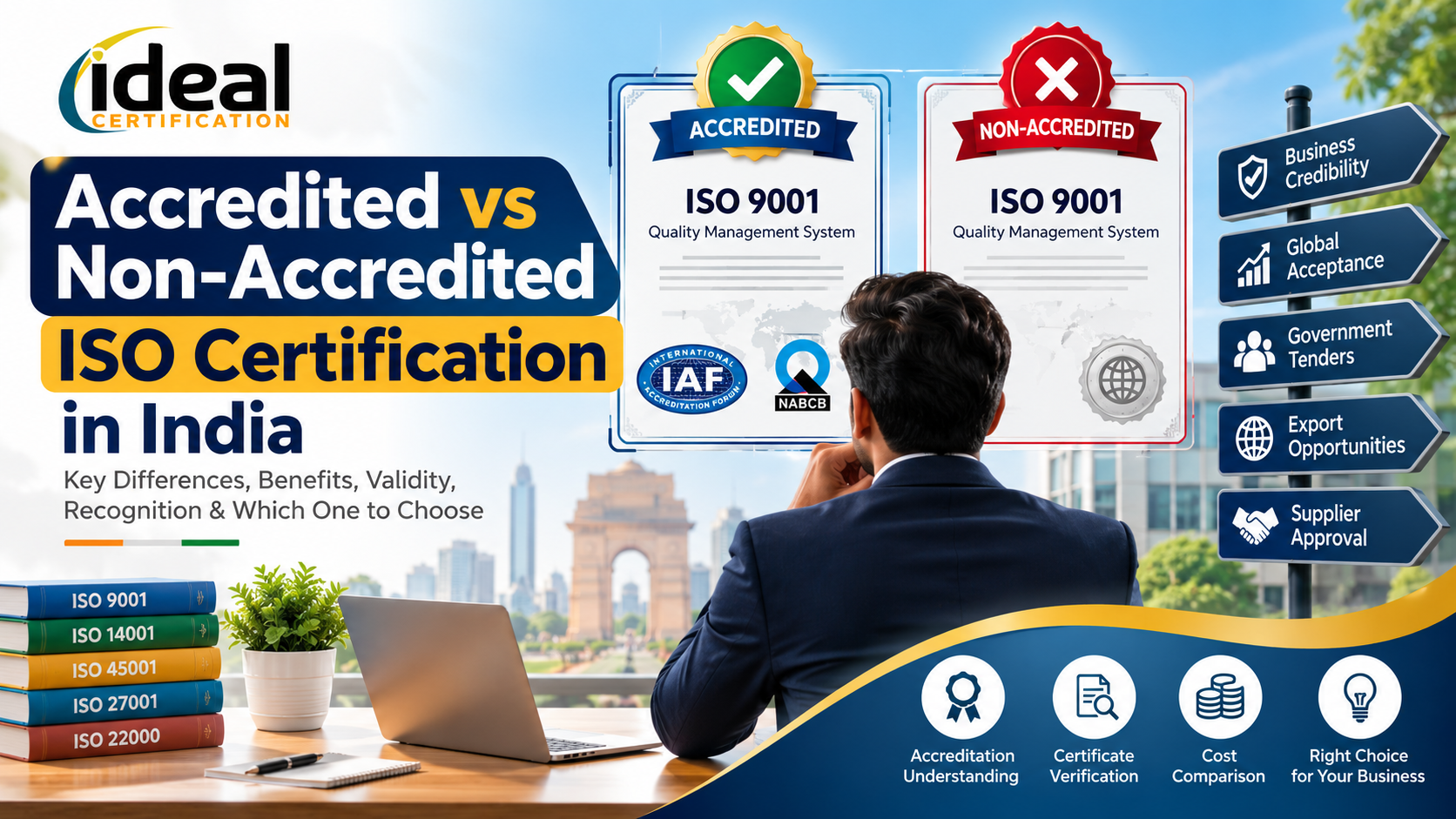
Accredited vs Non-Accredited ISO Certification
24 Aug 2026
ISO certification can help organizations demonstrate that their management systems follow the requirements of a recognized international standard. However, not every ISO certificate has the same certification pathway or level of independent oversight.
One of the most important distinctions businesses should understand is accredited vs non-accredited ISO certification.
The difference is not simply whether a certificate has an ISO logo or whether it looks official. It involves the relationship between the organization being certified, the certification body, and the accreditation body.
For Indian businesses applying for ISO 9001, ISO 14001, ISO 45001, ISO 27001, ISO 22000, ISO 13485 and other management-system certifications, understanding this distinction can help when evaluating customer requirements, tenders, supplier approvals, exports and other commercial needs.
What Is ISO Certification?
ISO certification is an independent conformity-assessment process in which a certification body evaluates an organization's management system against the requirements of a particular ISO standard.
For example:
- ISO 9001 – Quality Management System
- ISO 14001 – Environmental Management System
- ISO 45001 – Occupational Health & Safety Management System
- ISO 27001 – Information Security Management System
- ISO 22000 – Food Safety Management System
- ISO 13485 – Medical Devices Quality Management System
Importantly, ISO itself does not issue ISO certificates. Certification is performed by external certification bodies. ISO defines certification as independent written assurance that a system, product or service meets specified requirements.
What Is Accredited ISO Certification?
An accredited ISO certification is issued by a certification body whose competence has been formally recognized by a relevant accreditation body for the applicable certification activity and scope.
In simple terms:
Business → Certification Body → Accreditation Body
The business undergoes an audit by the certification body. The certification body's competence and operation are subject to accreditation oversight.
Accreditation therefore provides an additional layer of independent confidence in the certification process. ISO explains that accreditation is formal recognition by an independent accreditation body that a certification body operates according to applicable international standards.
In India, businesses may encounter NABCB (National Accreditation Board for Certification Bodies) when checking accredited management-system certification bodies. NABCB publishes information on certification bodies accredited for areas such as QMS, EMS, FSMS, ISMS, OHSMS and other management systems.
What Is Non-Accredited ISO Certification?
A non-accredited ISO certification is a certificate issued by a certification provider that does not hold applicable accreditation for the certification activity being offered.
This does not automatically mean that the provider is fraudulent or that the management system has no value. ISO itself notes that accreditation is not compulsory in every circumstance, and non-accreditation does not necessarily mean a certification body is not reputable.
However, the important practical question is:
Will the organization that receives the certificate accept it for its intended purpose?
That could include a customer, tender authority, multinational buyer, export customer, principal company, supplier-approval team or regulatory stakeholder.
Therefore, businesses should determine their actual requirement before choosing between accredited and non-accredited certification.
Accredited vs Non-Accredited ISO Certification: Main Differences
| Factor | Accredited ISO Certification | Non-Accredited ISO Certification |
|---|---|---|
| Certification body | Accredited for the relevant activity/scope | Not accredited for that certification activity |
| Independent oversight | Accreditation provides additional independent recognition of competence | No applicable accreditation oversight |
| Verification | Can generally be checked through relevant accreditation/certification records | Verification depends more heavily on the issuing provider |
| Tender requirements | May be specifically requested where applicable | May not satisfy a tender's stated requirement |
| Customer acceptance | Often preferred where customers specify accredited certification | Acceptance depends on customer requirements |
| Export/supplier requirements | Can be useful where buyers require accredited certification | Acceptance must be confirmed with the buyer |
| Cost | May be higher depending on scope and audit arrangements | Pricing can vary and may be lower |
| Suitability | Appropriate when accreditation is specifically required or commercially important | May be suitable where accreditation is not required |
The key point is that there is no universal rule that every ISO certificate must be accredited. The appropriate choice depends on the purpose of certification and the requirements of the parties that will rely on it.
ISO Certification vs Accreditation: What Is the Difference?
These two terms are frequently confused.
Certification
Certification evaluates an organization's management system against the requirements of a standard.
For example, a company may seek ISO 9001 certification to demonstrate that its quality management system conforms to ISO 9001 requirements.
Accreditation
Accreditation evaluates the competence of a conformity-assessment or certification body.
Therefore:
Certification = assessment of the organization's management system
Accreditation = recognition of the certification body's competence
This distinction is particularly important when selecting an accredited certification body in India.
Is Accredited ISO Certification Better Than Non-Accredited Certification?
The practical answer depends on the intended use.
If a customer, government tender, multinational buyer, regulatory framework or supplier qualification process specifically requires accredited ISO certification, an organization should ensure that its certification body has the appropriate accreditation and scope.
If accreditation is not required, a non-accredited certification may still be considered by a particular customer or organization.
Rather than choosing solely on price, businesses should first ask:
- Who will use or review the certificate?
- Is accredited certification explicitly required?
- Which ISO standard is required?
- Does the certification body's accreditation cover that standard?
- Does the accreditation cover the relevant industry or certification scope?
- Can the certificate and certification status be independently verified?
- What audit and surveillance arrangements apply?
This approach helps avoid obtaining a certificate that does not meet the actual commercial requirement.
How to Check an Accredited ISO Certification Body in India
Before engaging a certification body, businesses should perform appropriate due diligence.
1. Identify the certification body
The certificate should clearly identify the organization responsible for certification.
2. Check the accreditation body
Determine which accreditation body recognizes the certification body and whether the accreditation is current.
For Indian management-system certification, NABCB maintains information on accredited certification bodies and their applicable areas.
3. Check the accreditation scope
This is one of the most important steps.
A certification body's accreditation should be relevant to the specific management-system standard and applicable scope. Simply seeing an accreditation claim on a website is not enough.
4. Verify the certificate
ISO identifies IAF CertSearch as a global database that aggregates information from accreditation bodies and certification bodies and can be used to verify accredited certification information.
If a certificate cannot immediately be located, that should not automatically be treated as proof that it is fake. Businesses should also contact the certification body and relevant accreditation body because databases and records may have coverage or updating limitations.
What Should an ISO Certificate Contain?
When reviewing an accredited ISO certificate, businesses should examine details such as:
- Organization's legal name
- Certification standard
- Certification scope
- Certificate number
- Certification body
- Accreditation information, where applicable
- Initial certification date
- Current issue date
- Expiry or validity information
- Applicable locations
- Certification status
- Relevant certification marks
The scope is particularly important because certification applies to the activities and locations described within the certificate's defined scope.
Do MSMEs Need Accredited ISO Certification?
Not necessarily.
Indian MSMEs can obtain ISO certification according to their business requirements, but whether accreditation is necessary depends on how the certificate will be used.
For example, an MSME supplying components to a large manufacturer may face different requirements from a small service company seeking ISO certification primarily to improve its internal management system.
Before applying, the business should check:
Customer requirement → Tender requirement → Industry requirement → Export requirement → Supplier approval requirement
This can prevent unnecessary expense while ensuring the certification selected serves its intended purpose.
Do Government Tenders Require Accredited ISO Certification?
Tender requirements vary.
Some tenders may specify an ISO certificate from an appropriately accredited certification body, while others may simply require certification to a particular standard. Businesses should therefore read the tender's eligibility and technical requirements carefully rather than assuming that every ISO certificate will be accepted.
Where a tender specifically requires accredited certification, the organization should verify the certification body's relevant accreditation and scope before proceeding.
How Ideal Certification Helps Businesses in India
Ideal Certification provides ISO certification consultancy and end-to-end support for businesses across India.
The website lists services covering major standards and certification areas including ISO 9001, ISO 14001, ISO 45001, ISO 27001, ISO 22000, ISO 13485, GMP, HACCP and other certification requirements. Its stated support includes documentation, gap analysis, audit preparation, implementation guidance and certification support.
The service is positioned for startups, MSMEs, manufacturers, exporters, IT companies, healthcare organizations, food businesses, service providers and other organizations.
Ideal Certification also states that its certification process is available online across India and that certificates are issued through accredited bodies. Businesses should always confirm that the specific certification body, standard and accreditation scope meet the requirements of their intended use.
Why Businesses Should Not Choose an ISO Certificate Only on Price
The cheapest ISO certificate may not necessarily satisfy a customer's or tender authority's requirements.
A more useful evaluation should consider:
- Certification body's credentials
- Accreditation status, where required
- Applicable accreditation scope
- Audit methodology
- Certification standard
- Certificate verification process
- Documentation support
- Audit preparation
- Certification timeline
- Surveillance requirements
- Total certification cost
- Customer and tender acceptance requirements
This creates a more reliable basis for selecting an ISO certification provider.
Frequently Asked Questions
What is the difference between accredited and non-accredited ISO certification?
Accredited certification is issued by a certification body that has applicable accreditation from an independent accreditation body. Non-accredited certification is issued without that applicable accreditation. ISO states that accreditation is not compulsory in every circumstance.
Is a non-accredited ISO certificate valid?
A non-accredited certificate may be accepted for some purposes, but acceptance depends on the customer, tender, contractual or other applicable requirements. It should not be assumed to satisfy requirements that specifically call for accredited certification.
How can I verify an ISO certificate in India?
Check the certificate details, certification body, accreditation information, certification scope and current status. For accredited certification, IAF CertSearch can provide verification information, while relevant accreditation-body records can provide additional confirmation.
Is NABCB an ISO certification body?
No. NABCB is an accreditation body that accredits conformity-assessment bodies in relevant areas. Certification itself is performed by certification bodies.
Does ISO issue ISO certificates?
No. ISO develops international standards but does not perform certification or issue ISO certificates. Certification is conducted by independent certification bodies.
Do exporters need accredited ISO certification?
Not universally. The requirement depends on the buyer, contract, market, tender or applicable industry requirements. Exporters should confirm the requirements of their specific customers or markets before selecting a certification route.
Is accredited ISO certification required for MSMEs?
Not automatically. MSMEs should determine whether their customers, tenders, contracts or other business requirements specifically require accredited certification.
How do I choose an accredited ISO certification body in India?
Check the certification body's accreditation status, relevant standard, accreditation scope, certification process, certificate verification mechanism and the requirements of the organization that will accept the certificate.
Conclusion
The difference between accredited vs non-accredited ISO certification is primarily about the independent accreditation of the certification body and the requirements attached to the certificate's intended use.
Accreditation can provide additional independent confidence in the competence of a certification body, but ISO notes that accreditation is not compulsory in every circumstance.
For Indian businesses, the right approach is to look beyond the certificate itself. Check the certification body, accreditation body, accreditation scope, certification scope, certificate status and acceptance requirements before making a decision.
If your business needs support with ISO 9001, ISO 14001, ISO 45001, ISO 27001, ISO 22000, ISO 13485, GMP, HACCP or other ISO certification services in India, Ideal Certification provides documentation, gap-analysis, audit-preparation and certification support through its stated online process.
Ideal Certification
Phone: +91-8126500772
Email: info@idealcertification.com
Address: Ground Floor, Shop No.11, EL - Commercia, Pr 7 Road, Near Maya Garden City, Gate No.3, Zirakpur, Punjab - 140603, India