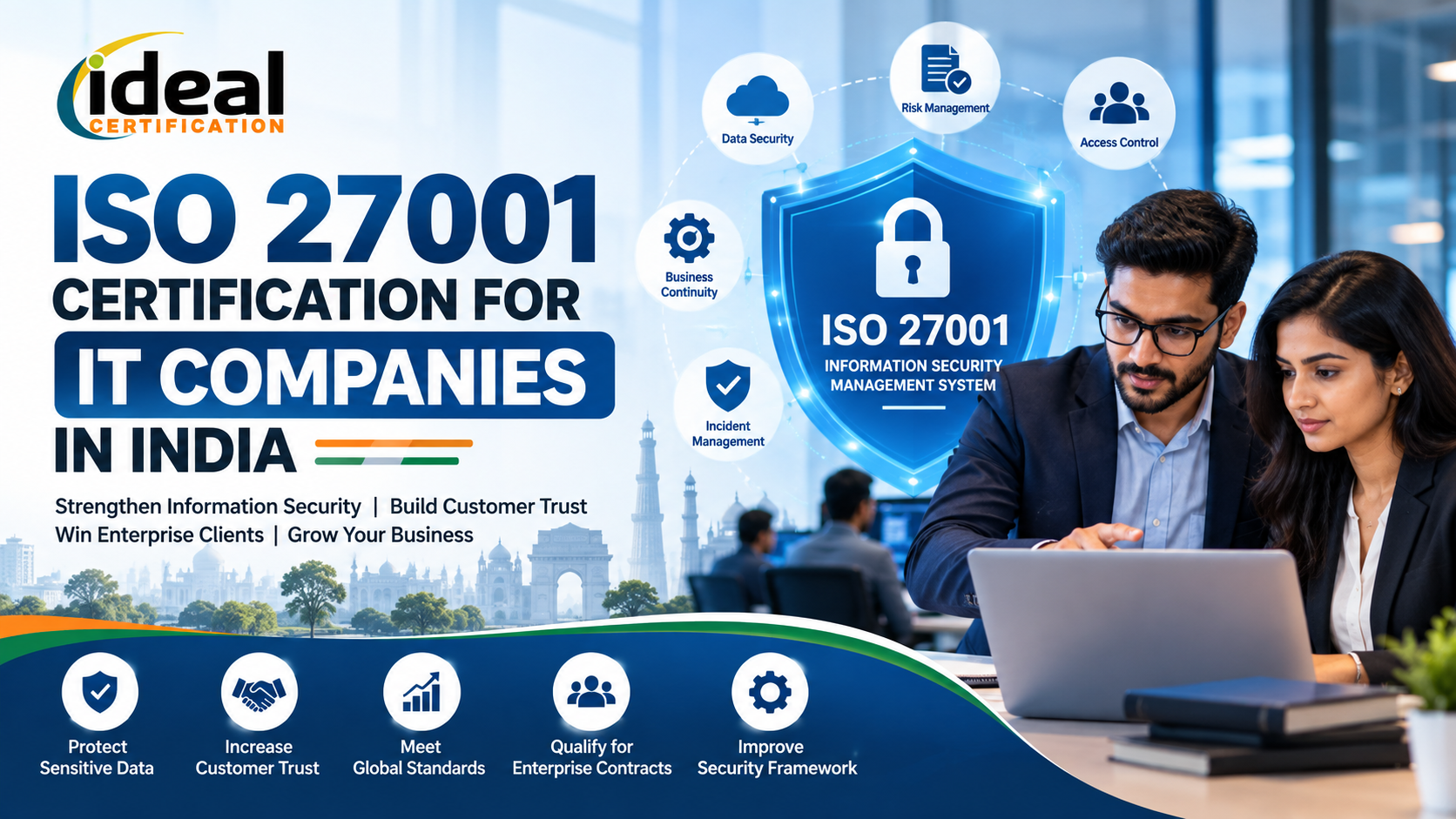
ISO 27001 Certification for IT Companies in India
14 Jul 2026
ISO 27001 Certification for IT Companies in India provides a structured framework for managing information-security risks, protecting sensitive information, and establishing an effective Information Security Management System (ISMS). For IT companies, software developers, SaaS businesses, BPOs, IT service providers, cloud companies, and technology startups, information security is no longer limited to firewalls and antivirus software. It involves people, processes, technology, suppliers, access controls, business continuity, risk management, and continual improvement.
ISO/IEC 27001:2022 is the internationally recognized standard for establishing, implementing, maintaining, and continually improving an Information Security Management System. It follows a risk-based approach, allowing an organization to identify the information-security risks that matter to its business and implement appropriate controls.
For Indian IT companies working with enterprise customers, overseas clients, government organizations, financial institutions, healthcare companies, or other data-sensitive businesses, ISO 27001 certification can also support customer due diligence, vendor evaluations, contractual requirements, and business credibility.
What Is ISO 27001 Certification for IT Companies?
ISO 27001 certification confirms that an organization's Information Security Management System has been assessed against the applicable requirements of ISO/IEC 27001 by an independent certification body.
An ISMS is much broader than a cybersecurity product or technical security solution. It creates a management framework for identifying information assets, assessing risks, implementing appropriate controls, assigning responsibilities, monitoring performance, conducting internal audits, reviewing the system, and continually improving information security.
For an IT company, the ISMS may cover areas such as:
- Software development and source-code management
- Cloud infrastructure
- Customer and employee information
- IT infrastructure and networks
- Applications and databases
- Business-critical systems
- Remote working environments
- Information-security policies
- Third-party service providers
- Data backup and recovery
- Incident management
- Access and identity management
The certification scope should be carefully defined according to the organization's actual activities and business objectives.
Why Do IT Companies Need ISO 27001 Certification?
IT businesses frequently handle valuable information such as customer records, credentials, source code, intellectual property, financial information, employee data, business documents, and proprietary applications.
Weak information-security practices can expose an organization to operational disruption, unauthorized access, data loss, contractual problems, and reputational damage.
ISO 27001 provides a systematic approach to managing these risks.
Key business benefits of ISO 27001 include:
1. Structured information-security management
Instead of managing security through disconnected policies and technical tools, an ISMS establishes a coordinated management framework.
2. Better risk identification
Organizations can identify information-security risks, evaluate their potential impact, and determine appropriate risk-treatment measures.
3. Stronger customer confidence
Enterprise customers increasingly assess the security practices of their technology suppliers. ISO 27001 certification can provide independent evidence that an organization operates a formal information-security management system.
4. Support for business development
ISO 27001 may be relevant when responding to RFPs, vendor questionnaires, enterprise procurement processes, and customer security requirements.
5. Improved internal accountability
An ISMS defines responsibilities for information security and establishes processes for monitoring, review, corrective action, and continual improvement.
6. Better security awareness
Employees become part of the information-security framework through policies, responsibilities, awareness and training.
7. Support for international business
An internationally recognized management-system certification can help Indian IT companies communicate their information-security practices to customers and partners in other markets.
ISO 27001 should not be presented as a guarantee against cyberattacks or data breaches. Its purpose is to establish a systematic, risk-based management framework for information security.
ISO 27001:2022 Requirements for IT Companies
The requirements applicable to an IT company depend on its ISMS scope, business activities, risk profile and organizational context.
A practical implementation generally involves understanding the organization's:
- Internal and external context
- Interested parties
- Information-security objectives
- ISMS scope
- Information-security risks
- Risk-treatment approach
- Applicable controls
- Monitoring and measurement requirements
- Internal-audit requirements
- Management-review process
- Continual-improvement requirements
Understanding ISO 27001 Annex A Controls
ISO/IEC 27001:2022 includes a reference set of 93 information-security controls in Annex A, organized into four groups:
- Organizational controls
- People controls
- Physical controls
- Technological controls
However, IT companies should not simply attempt to implement every control without considering their business risks.
The organization determines which controls are applicable based on its risk assessment and other relevant considerations. The Statement of Applicability (SoA) records the selected controls, their applicability and implementation status.
This risk-based approach is particularly important for startups and smaller IT companies because the ISMS should be proportionate to the organization's actual operations.
ISO 27001 Certification Process for IT Companies in India
The ISO 27001 certification journey should be approached as a management-system implementation rather than a document-generation exercise.
Step 1: Understand the Organization and Define the Scope
The first stage is determining what will be included within the ISMS.
For example, a SaaS company may define a scope around its SaaS platform, supporting infrastructure, employees, development operations, cloud environment and related business processes.
A well-defined scope prevents unnecessary complexity and helps ensure that the certification reflects the organization's actual services.
Step 2: Conduct an ISO 27001 Gap Analysis
A gap analysis compares existing information-security practices with the applicable ISO 27001 requirements.
The review may identify gaps involving:
- Policies
- Risk management
- Access control
- Asset management
- Incident response
- Supplier management
- Business continuity
- Employee awareness
- Internal auditing
- Management review
- Security monitoring
The resulting gap assessment provides a practical roadmap for implementation.
Step 3: Perform Information-Security Risk Assessment
Risk assessment is a central part of ISO 27001.
The organization identifies important information assets and evaluates potential threats, vulnerabilities, likelihood and impact.
Examples of risks for an IT company could include:
- Unauthorized access to customer systems
- Loss of company laptops
- Compromised employee credentials
- Malware or ransomware
- Source-code exposure
- Cloud misconfiguration
- Third-party security failures
- Data loss
- Service interruption
- Unauthorized changes to applications
The company then determines how those risks should be treated.
Step 4: Develop and Implement the ISMS
Based on the organization's risks, appropriate policies, procedures, controls and operational processes are established.
Implementation may involve:
- Information-security policies
- Access-control procedures
- Password and authentication controls
- Asset-management procedures
- Incident-management processes
- Backup procedures
- Business-continuity measures
- Supplier-security controls
- Employee-security awareness
- Secure development practices
- Monitoring and review mechanisms
Step 5: Prepare the Required Documentation
Documentation should be relevant to the organization's actual operations.
Common ISO 27001 documentation may include:
- ISMS scope
- Information-security policy
- Risk assessment methodology
- Risk assessment
- Risk treatment plan
- Statement of Applicability
- Information-security objectives
- Asset inventory
- Access-control procedures
- Incident-management procedures
- Business continuity procedures
- Supplier-security documentation
- Training and awareness records
- Internal-audit records
- Management-review records
- Corrective-action records
The exact documentation should be determined by the company's scope and operational requirements.
Step 6: Internal Audit and Management Review
Before the external certification audit, the organization should evaluate whether its ISMS is operating as intended.
An internal audit helps identify potential nonconformities and improvement opportunities.
Management review then provides top management with an opportunity to evaluate ISMS performance, risks, audit results, objectives and improvement requirements.
Step 7: Certification Audit
An independent certification body conducts the certification audit.
The audit generally assesses whether the organization's ISMS meets applicable ISO/IEC 27001 requirements and whether the system has been effectively implemented.
ISO itself does not issue certificates to organizations. Certification is performed by independent certification bodies.
ISO 27001 Certification for Software Companies in India
Software companies often manage source code, customer information, development environments, intellectual property and production systems.
ISO 27001 can provide a structured framework for addressing risks associated with:
- Software development
- Source-code repositories
- Developer access
- Application security
- Change management
- Testing environments
- Production access
- Cloud infrastructure
- Third-party software
- Customer information
For software businesses selling to enterprise customers, demonstrating a structured approach to information security can be particularly relevant during vendor assessments.
ISO 27001 Certification for SaaS Companies
SaaS companies operate in an environment where customers may expect strong controls around cloud infrastructure and information security.
A SaaS-focused ISMS may address:
- Customer-data protection
- Cloud security
- Identity and access management
- Infrastructure security
- Backup and recovery
- Incident response
- Vulnerability management
- Secure software development
- Third-party providers
- Employee access
- Business continuity
The certification scope should clearly define the SaaS service and supporting processes included within the ISMS.
ISO 27001 for IT Services and BPO Companies
IT service providers and BPO organizations frequently access information belonging to customers.
Their security responsibilities may include protecting:
- Customer databases
- Credentials
- Business documents
- Employee information
- IT infrastructure
- Communication systems
- Support systems
- Confidential customer information
An appropriately designed ISMS can help organizations formalize these responsibilities and establish repeatable security processes.
ISO 27001 Certification Cost for IT Companies in India
The ISO 27001 certification cost in India is not a fixed amount.
The final cost depends on several factors, including:
- Size of the organization
- Number of employees
- Number of locations
- Certification scope
- Complexity of operations
- Existing information-security controls
- Number of systems and applications
- Cloud infrastructure
- Implementation requirements
- Consultancy requirements
- Certification audit duration
For this reason, businesses should avoid selecting a certification provider solely on the basis of the lowest advertised price.
A reliable quotation should clearly explain the proposed scope, consultancy or implementation support, audit arrangements and certification-related costs.
How Long Does ISO 27001 Certification Take?
There is no universal ISO 27001 certification timeline for every IT company.
A small organization with a focused scope and mature information-security practices may require less preparation than a larger organization with multiple locations, complex infrastructure and extensive customer operations.
The timeline can be influenced by:
- ISMS maturity
- Scope
- Company size
- Documentation readiness
- Risk assessment
- Control implementation
- Internal audit
- Management review
- Certification-body scheduling
The objective should be to establish an effective and sustainable ISMS rather than simply obtain a certificate as quickly as possible.
Is ISO 27001 Mandatory for IT Companies in India?
ISO 27001 is not universally mandatory for every IT company in India.
However, specific customers, contracts, RFPs, procurement requirements, tenders, industry expectations or organizational policies may require an information-security certification.
Therefore, an IT company should determine whether ISO 27001 is required based on its particular customers, contracts, market and regulatory environment.
This distinction is important because the business reason for certification can vary considerably between organizations.
ISO 27001 and Enterprise Customer Requirements
One of the practical reasons IT companies consider ISO 27001 is customer due diligence.
A prospective enterprise customer may ask questions about:
- Information-security policies
- Access control
- Incident response
- Risk management
- Business continuity
- Supplier security
- Data protection
- Employee awareness
- Security monitoring
- Independent certification
An ISO 27001-certified ISMS can provide a structured foundation for responding to such requirements.
It does not replace customer-specific security questionnaires or contractual obligations, but it can demonstrate that information security is being managed through a formal system.
How Ideal Certification Can Support Your ISO 27001 Journey
Implementing ISO 27001 requires more than downloading templates and preparing documents.
Ideal Certification can support organizations through the certification journey with practical guidance based on the organization's scope and requirements.
Support can include:
- Initial consultation
- Scope identification
- Gap analysis
- ISO 27001 documentation guidance
- ISMS implementation support
- Risk-assessment guidance
- Risk-treatment planning
- Statement of Applicability guidance
- Internal-audit preparation
- Management-review preparation
- Certification-audit preparation
- Certification coordination
The exact support required depends on the organization's existing systems and certification objectives.
How to Select an ISO 27001 Certification Consultant in India
Before choosing an ISO 27001 consultant, an IT company should evaluate more than price.
Consider whether the provider:
- Understands ISO/IEC 27001:2022
- Has experience with technology businesses
- Understands ISMS implementation
- Can explain certification scope clearly
- Provides transparent commercial terms
- Offers practical implementation guidance
- Understands risk-based security management
- Helps prepare for the certification audit
- Clearly distinguishes consultancy from independent certification
A good implementation approach should help the organization understand and operate its ISMS rather than simply prepare paperwork for an audit.
ISO 27001 Certification for Startups and Small IT Companies
Small businesses and startups sometimes assume ISO 27001 is only suitable for large enterprises.
That is not necessarily the case.
ISO/IEC 27001 can be applied to organizations of different sizes. The important consideration is creating an ISMS appropriate to the organization's scope, operations and risks.
For a startup, a focused certification scope may cover a particular SaaS product, development operation or service rather than the entire business.
A practical implementation can therefore help smaller technology companies build formal information-security processes while preparing for enterprise customer requirements.
Frequently Asked Questions About ISO 27001 Certification
1. What is ISO 27001 certification for IT companies in India?
ISO 27001 certification demonstrates that an IT organization has established an Information Security Management System that has been independently assessed against applicable ISO/IEC 27001 requirements.
2. Is ISO 27001 mandatory for IT companies in India?
No. ISO 27001 is not universally mandatory for all IT companies. However, particular customers, contracts, tenders or procurement requirements may request or require certification.
3. How much does ISO 27001 certification cost for an IT company?
The cost varies according to the company's size, scope, locations, existing controls, implementation requirements and certification audit arrangements. A customized assessment is recommended for an accurate quotation.
4. What documents are required for ISO 27001 certification?
Typical documentation includes the ISMS scope, information-security policy, risk assessment, risk-treatment plan, Statement of Applicability, applicable procedures, internal-audit records and management-review records. The exact documentation depends on the organization's scope and risks.
5. Can a small IT company or SaaS startup get ISO 27001 certification?
Yes. ISO/IEC 27001 can be implemented by organizations of different sizes. The ISMS should be appropriately scoped and proportionate to the organization's activities, risks and business requirements.
Conclusion
Information security is now a fundamental business consideration for IT companies operating in India's rapidly growing technology ecosystem. Customers increasingly want confidence that their technology partners have structured processes for managing sensitive information and security risks.
ISO 27001 Certification for IT Companies in India provides a recognized framework for establishing an Information Security Management System, identifying information-security risks, implementing appropriate controls, monitoring performance and continually improving the organization's security management practices.
Whether you operate a software company, SaaS business, IT service provider, BPO, cloud business, technology startup or another information-driven organization, the right ISO 27001 approach can help you build a more structured information-security management system and respond more effectively to customer and business requirements.
Start Your ISO 27001 Certification Journey with Ideal Certification
Ideal Certification provides ISO certification support for businesses across India, with guidance tailored to the organization's requirements and certification scope.
For consultation regarding ISO 27001 certification, ISMS implementation, documentation, risk assessment, gap analysis or certification preparation, contact:
Email: info@idealcertification.com
Phone: +91-8126500772
Address: Ground Floor, Shop No. 11, EL-Commercia, PR 7 Road, Near Maya Garden City, Gate No. 3, Zirakpur, Punjab – 140603
Request an ISO 27001 consultation today and discuss your organization's certification requirements with Ideal Certification.