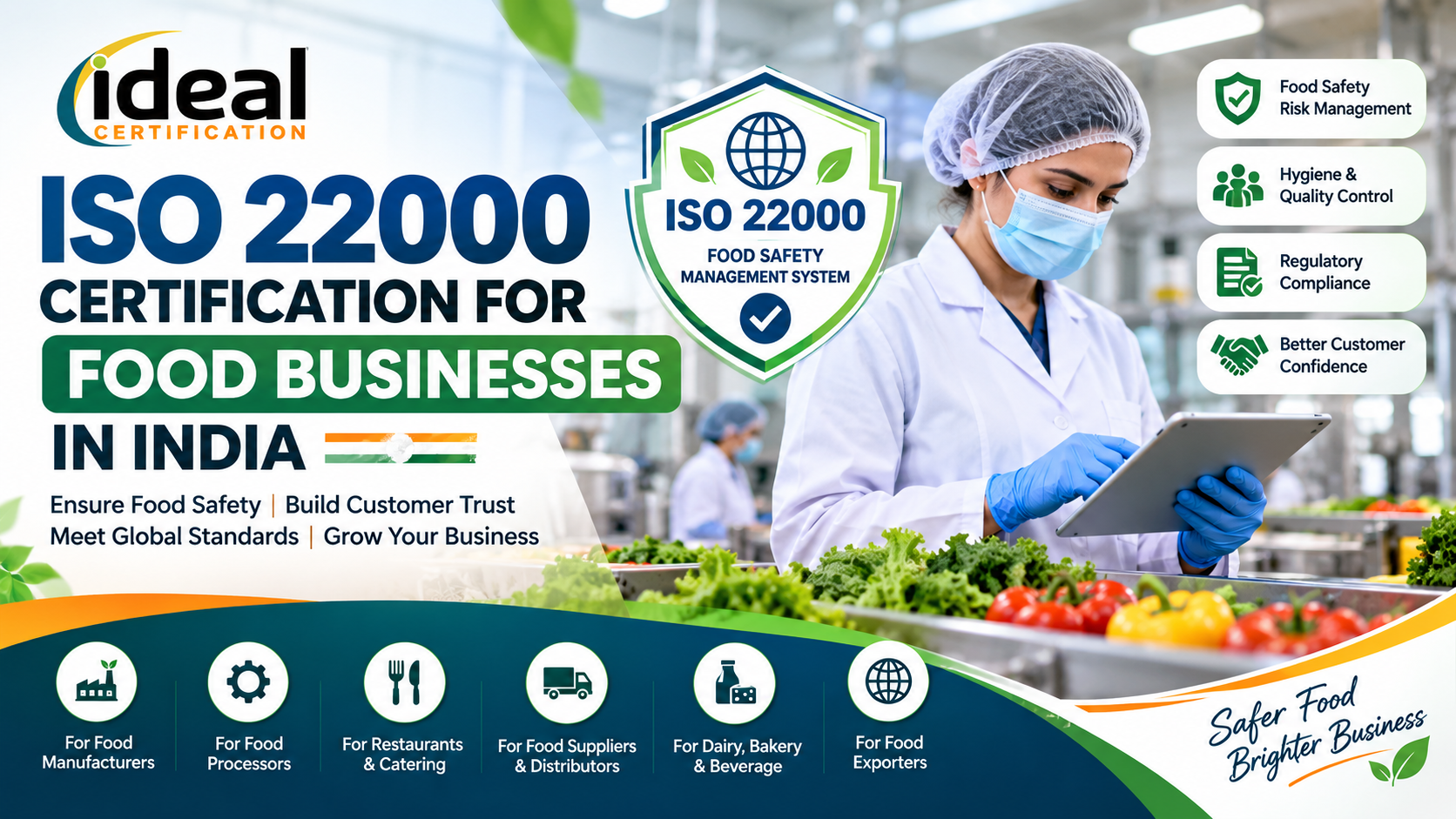
ISO 22000 Certification for Food Businesses in India
18 Jul 2026
Food safety is no longer only a production-floor concern. For food manufacturers, processors, restaurants, caterers, exporters, distributors, retailers, and other organizations in the food chain, a systematic approach to identifying and controlling food-safety risks is increasingly important for customer confidence, business growth, supplier approval, and market access.
ISO 22000 Certification for Food Businesses in India provides a structured framework for establishing and maintaining a Food Safety Management System (FSMS). It helps organizations identify food-safety hazards, establish appropriate controls, monitor processes, manage risks, and continually improve their food-safety performance.
ISO 22000:2018 applies to organizations of different sizes and types that are directly or indirectly involved in the food chain. The standard integrates food-safety management principles with HACCP-based hazard control and prerequisite programmes.
At Ideal Certification, businesses can receive end-to-end support for ISO 22000:2018 certification, including gap analysis, documentation, implementation guidance, audit preparation, and coordination for certification. The company states that its certification process is online and paperless and serves businesses across India.
What Is ISO 22000 Certification?
ISO 22000 certification demonstrates that an organization's Food Safety Management System has been assessed against the applicable requirements of ISO 22000 by an independent certification body.
ISO 22000 is specifically focused on food safety, rather than general product quality alone. It is designed to help organizations consistently provide safe food and manage food-safety hazards throughout relevant stages of the food chain.
The standard brings together important food-safety concepts such as:
- Food Safety Management System (FSMS)
- HACCP principles
- Hazard identification and risk assessment
- Prerequisite programmes (PRPs)
- Operational prerequisite programmes (OPRPs)
- Critical Control Points (CCPs)
- Food-safety objectives
- Monitoring and measurement
- Traceability
- Internal audits
- Management review
- Corrective action and continual improvement
- Communication throughout the food chain
ISO explains that the standard combines interactive communication, system management, prerequisite programmes and HACCP principles into its food-safety framework.
Who Needs ISO 22000 Certification in India?
ISO 22000 is relevant to a broad range of businesses involved in the food supply chain.
Depending on the organization's activities and certification scope, this can include:
Food Manufacturing Companies
Food manufacturers can use ISO 22000 to establish systematic controls over raw materials, processing, storage, production environments, personnel hygiene, contamination risks and finished products.
Food Processing Businesses
Food processing companies can use an FSMS to identify hazards at different processing stages and establish appropriate preventive and control measures.
Restaurants and Catering Businesses
Restaurants, hotels, catering companies and food-service organizations can use food-safety management practices to control risks related to ingredients, preparation, storage, hygiene and service.
Dairy and Beverage Businesses
Milk, dairy, beverage and related businesses can benefit from structured controls covering suppliers, raw materials, processing, storage and distribution.
Bakeries and Confectionery Businesses
Commercial bakeries and confectionery manufacturers can implement controls for ingredients, allergens, sanitation, processing, packaging, storage and traceability.
Food Exporters
For exporters, an effective food-safety management system can support customer confidence and supplier qualification requirements in international markets.
Food Packaging and Supply-Chain Organizations
Organizations involved in food-contact packaging, transportation, storage, distribution and other food-chain activities may also fall within the scope of ISO 22000. ISO specifically describes applicability across the food chain, including production, manufacturing, distribution, food service and related activities.
Why Is ISO 22000 Important for Food Businesses?
Food businesses operate in an environment where a food-safety failure can affect consumers, reputation, contracts and business continuity.
ISO 22000 provides a management-system approach for identifying and controlling food-safety hazards rather than relying only on individual inspections or isolated procedures.
Key business benefits can include:
- More systematic food-safety risk management
- Better process control
- Improved traceability
- Greater customer confidence
- Better supplier and vendor qualification
- Support for export and international business requirements
- Improved preparedness for audits
- Stronger food-safety documentation
- Better internal accountability
- Support for continual improvement
- Improved credibility with corporate buyers
ISO also identifies improved food safety, regulatory support, customer confidence, operational efficiency and market access among the potential benefits of ISO 22000.
However, ISO 22000 certification does not itself replace applicable food laws, licenses or regulatory approvals. Businesses still need to comply with the legal and regulatory requirements applicable to their operations.
ISO 22000:2018 Requirements for Food Businesses
An effective ISO 22000 FSMS needs to be appropriate to the organization's activities, food-safety risks, products, processes and certification scope.
Important areas include:
1. Understanding the Organization and Its Context
The organization needs to understand relevant internal and external factors, interested parties, and the scope of its FSMS.
2. Food Safety Leadership and Responsibility
Management should establish appropriate food-safety policies, responsibilities, authorities and objectives.
3. Hazard Analysis
Food-safety hazards need to be identified and evaluated at relevant stages of the food chain.
This can involve consideration of:
- Biological hazards
- Chemical hazards
- Physical hazards
- Allergens and other relevant risks
4. Prerequisite Programmes
PRPs establish the basic operational and hygienic conditions needed to support safe food production.
Depending on the sector, these may involve:
- Cleaning and sanitation
- Personal hygiene
- Pest control
- Equipment maintenance
- Water quality
- Waste management
- Storage conditions
- Supplier controls
- Cross-contamination prevention
5. HACCP-Based Controls
ISO 22000 incorporates HACCP principles and application steps developed by the Codex Alimentarius Commission.
The organization needs to determine appropriate control measures and establish monitoring and corrective-action arrangements.
6. Monitoring and Verification
Food-safety controls need to be monitored and verified to determine whether the FSMS is operating effectively.
7. Internal Audit and Management Review
Internal audits help identify weaknesses and opportunities for improvement before the certification audit.
Management review provides senior management with a structured way to evaluate the effectiveness and continuing suitability of the FSMS.
ISO 22000 and HACCP: What Is the Difference?
A common question among food businesses is whether HACCP and ISO 22000 are the same.
They are related, but they are not identical.
HACCP is a food-safety methodology focused on identifying hazards and controlling significant risks through defined principles and control measures.
ISO 22000 is a broader Food Safety Management System standard that incorporates HACCP principles alongside management-system requirements, communication, prerequisite programmes, monitoring, evaluation and continual improvement.
This is why businesses often consider HACCP and ISO 22000 together when developing a structured food-safety system.
Ideal Certification also provides HACCP certification services alongside ISO 22000 certification support.
ISO 22000 Certification Process in India
The exact process depends on the organization's size, scope, complexity and readiness, but a typical certification journey includes:
Step 1: Initial Consultation
The certification scope, business activities, locations, products and applicable requirements are discussed.
Step 2: Gap Analysis
Existing food-safety practices are reviewed against the applicable ISO 22000 requirements.
Step 3: FSMS Documentation
Relevant policies, procedures, records, hazard-analysis documents, food-safety plans and supporting documentation are developed or improved.
Step 4: Implementation
The organization implements the defined food-safety controls and ensures that employees understand their responsibilities.
Step 5: Internal Audit
An internal audit is conducted to identify nonconformities and areas requiring corrective action.
Step 6: Management Review
Management evaluates the performance and effectiveness of the FSMS.
Step 7: Certification Audit
An independent certification body evaluates the organization's FSMS against the applicable certification requirements.
Step 8: Certification
After successful completion of the certification process and resolution of applicable findings, the certification body can issue the certificate.
Importantly, ISO itself does not certify organizations. Certification is performed by independent certification bodies.
Documents Required for ISO 22000 Certification
The exact documentation depends on the organization's activities and scope. Common business and certification information may include:
- Company registration documents
- Address proof
- Application details
- Product and process information
- Organization structure
- Food-safety policy
- Food-safety objectives
- Process information
- Hazard analysis
- Food-safety plans
- PRP documentation
- Monitoring records
- Traceability records
- Supplier-control records
- Training records
- Internal audit records
- Management review records
- Corrective-action records
Ideal Certification's ISO 22000 service page also identifies registration proof, address proof, bills/invoices and an application form among its basic documentation requirements.
ISO 22000 Certification Cost in India
There is no single fixed ISO 22000 certification cost for every food business.
The total cost can depend on factors such as:
- Number of employees
- Number of locations
- Certification scope
- Nature of food-processing activities
- Product categories
- Operational complexity
- Existing FSMS maturity
- Audit requirements
- Documentation and implementation requirements
- Certification-body fees
- Consultant or implementation support
- Travel or site-audit requirements, where applicable
A small food business with a limited scope may have substantially different requirements from a multi-site food manufacturer or exporter.
For this reason, businesses should request a scope-specific ISO 22000 certification quotation rather than relying on a generic online price.
How Long Does ISO 22000 Certification Take?
The certification timeline depends on organizational readiness, scope, complexity, documentation, implementation and audit requirements.
A business that already has established food-safety processes and records may require less preparation than an organization starting from scratch.
Ideal Certification provides online and paperless support and states that its consultants assist with documentation, gap analysis, implementation guidance and audit preparation.
The important objective should be audit readiness and effective implementation, rather than simply obtaining a certificate as quickly as possible.
Is ISO 22000 Certification Mandatory in India?
ISO 22000 certification is not automatically mandatory for every food business.
ISO describes certification as voluntary, although organizations may choose certification when customers, buyers, procurement processes or other commercial requirements call for independent confirmation of their food-safety management system.
Food businesses must separately comply with applicable Indian food-safety and regulatory requirements.
ISO 22000 can therefore be viewed as a structured management-system framework that may strengthen an organization's food-safety controls and commercial credibility.
ISO 22000 Certification and Government Tenders
For businesses supplying products or services to government departments, large organizations or institutional buyers, certification requirements can vary from one tender or procurement specification to another.
Ideal Certification states that it provides compliance support for government and corporate tenders and serves businesses seeking ISO certification for tenders, exports and vendor requirements.
Businesses should always check the specific tender's eligibility criteria instead of assuming that ISO 22000 alone guarantees eligibility.
Choosing an ISO 22000 Certification Consultant in India
Before selecting an ISO certification consultant, consider whether the provider can explain:
- Which standard applies to your business
- Appropriate certification scope
- Food-safety documentation requirements
- Hazard-analysis expectations
- HACCP integration
- Internal-audit preparation
- Certification audit stages
- Certification-body arrangements
- Applicable accreditation considerations
- Costs and additional charges
- Post-certification requirements
NABCB maintains information on certification bodies operating within its accreditation framework for Food Safety Management Systems.
A consultant can support preparation and implementation, but the certification decision should remain with the independent certification body.
Why Choose Ideal Certification for ISO 22000?
Ideal Certification positions itself as an India-wide ISO certification service provider offering end-to-end assistance for businesses of different sizes and industries.
For ISO 22000, its published service offering includes:
- Initial consultation
- Gap analysis
- FSMS documentation support
- Food-safety risk-control guidance
- Implementation support
- Internal-audit preparation
- Certification-audit preparation
- Certification coordination
- Online and paperless process
- Support for businesses across India
- Transparent pricing approach
- Tender and business-compliance support
The company states that it has helped 5,000+ businesses and serves sectors including food processing, manufacturing, healthcare, IT, education, e-commerce, retail and logistics.
View Ideal Certification's ISO 22000:2018 Certification Service
Frequently Asked Questions About ISO 22000 Certification
1. What is ISO 22000 certification for food businesses in India?
ISO 22000 certification verifies that an organization's Food Safety Management System has been assessed against the applicable ISO 22000 requirements by an independent certification body.
2. Is ISO 22000 mandatory for food businesses in India?
No. ISO 22000 certification is voluntary in itself, although customers, buyers, tenders or business contracts may specify certification requirements. Applicable food-safety laws and regulatory requirements remain separate obligations.
3. What is the cost of ISO 22000 certification in India?
There is no universal price. Cost depends on factors such as business size, scope, locations, operational complexity, audit requirements and certification arrangements.
4. What documents are required for ISO 22000 certification?
Typical requirements can include company registration and address documents, food-safety policies, process information, hazard analysis, food-safety plans, monitoring records, training records, internal-audit records and management-review records.
5. Is ISO 22000 suitable for small food businesses?
Yes. ISO 22000 is designed for organizations across the food chain and can be applied to organizations of different sizes and levels of complexity.
6. What is the difference between ISO 22000 and HACCP?
HACCP focuses on systematic identification and control of food-safety hazards, while ISO 22000 provides a broader food-safety management-system framework incorporating HACCP principles and additional management-system requirements.
7. Is ISO 22000:2018 still current?
As of September 2026, ISO 22000:2018 remains the published/current edition, with Amendment 1:2024 covering climate-action changes. ISO/DIS 22000 is currently under development and is intended to replace ISO 22000:2018.
Get ISO 22000 Certification Support for Your Food Business
Whether you operate a food manufacturing unit, food-processing company, restaurant, bakery, dairy business, catering service, food exporter, distributor, packaging operation or another food-chain organization, establishing an effective FSMS can help you manage food-safety risks in a more structured way.
Ideal Certification provides ISO 22000 certification support across India, including assistance with gap analysis, documentation, implementation guidance, audit preparation and certification coordination.
Request a customized ISO 22000 consultation based on your business activities, certification scope and requirements.
Ideal Certification
Email: info@idealcertification.com
Phone / WhatsApp: +91-8126500772
Address: Ground Floor, Shop No.11, EL-Commercia, PR 7 Road, Near Maya Garden City, Gate No.3, Zirakpur, Punjab – 140603, India