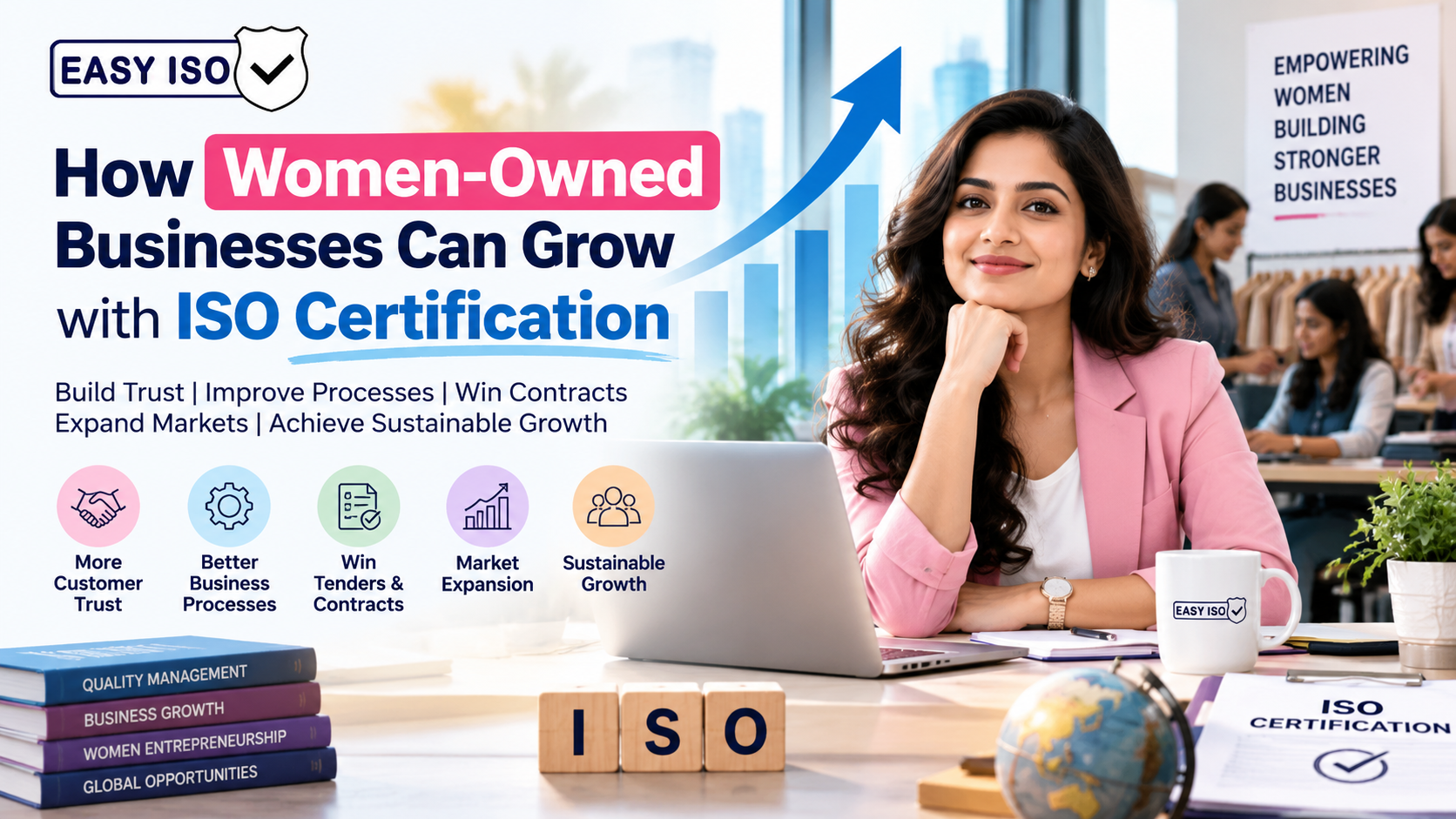
How Women-Owned Businesses Can Grow with ISO Certification
06 Jul 2026
Women-owned businesses are becoming an important part of India's growing entrepreneurial and MSME ecosystem. Women entrepreneurs are building companies across manufacturing, food processing, IT, healthcare, education, retail, e-commerce, consulting, professional services and other sectors.
But as a business moves from the startup stage to sustained growth, having a good product or service is only one part of the equation. Customers increasingly look for consistency, reliable processes, documented systems and evidence that a business takes quality seriously.
This is where ISO certification for women-owned businesses in India can become a valuable business-development tool.
ISO certification provides a structured framework for managing important business processes. Depending on the organization's activities and objectives, standards such as ISO 9001, ISO 14001, ISO 45001, ISO 27001 and ISO 22000 can help organizations establish systematic approaches to quality, environmental management, occupational health and safety, information security or food safety.
For women entrepreneurs, ISO certification should not be viewed simply as a certificate to display. When properly implemented, it can become part of a broader strategy for improving operations, strengthening credibility and preparing the business for new opportunities.
What Is ISO Certification for Women-Owned Businesses?
ISO certification is the result of an assessment of an organization's management system against the requirements of a particular ISO standard.
The applicable standard depends on the nature of the business.
For example:
- ISO 9001 focuses on quality management systems.
- ISO 14001 focuses on environmental management.
- ISO 45001 focuses on occupational health and safety.
- ISO 27001 focuses on information security management.
- ISO 22000 focuses on food safety management.
- ISO 13485 is designed for quality management in the medical-device sector.
- HACCP provides a systematic approach to identifying and controlling food-safety hazards.
Therefore, there is no single ISO certification that is automatically the "best" for every women-owned company.
The correct choice depends on the organization's products, services, processes, customers, risks and commercial objectives.
Why Is ISO Certification Important for Women Entrepreneurs?
Growing businesses often face a common challenge: informal processes that worked when the company was small may become difficult to manage as employees, customers and operations increase.
ISO management systems encourage businesses to define responsibilities, document important processes, monitor performance, identify risks and continually improve.
For a women-owned business, this can support growth in several practical ways.
1. Build Greater Customer Confidence
Customer confidence is one of the most valuable assets for a growing company.
An ISO management system can demonstrate that the organization has established defined processes for managing quality, customer requirements and continual improvement.
For example, an organization implementing ISO 9001 may establish clearer procedures for handling customer requirements, monitoring service or product quality, managing complaints and taking corrective action.
This can help present the business as organized, process-driven and committed to consistency.
2. Improve Internal Business Processes
Business growth becomes difficult when everything depends on the owner.
A structured management system helps convert informal working methods into repeatable processes.
This can help address areas such as:
- Process documentation
- Roles and responsibilities
- Quality controls
- Supplier evaluation
- Customer feedback
- Risk identification
- Corrective action
- Performance monitoring
- Internal audits
- Continual improvement
For women entrepreneurs managing a growing team, process standardization can make day-to-day operations more organized and easier to monitor.
3. Strengthen Business Credibility
A certification can be particularly useful when a company needs to demonstrate its management-system credentials to customers, suppliers or other business stakeholders.
For example, a manufacturer seeking new B2B customers may be asked about its quality-management practices.
Similarly, an IT company handling customer information may need to demonstrate appropriate information-security controls.
In such situations, the relevant ISO certification can form part of the organization's overall credibility and compliance profile.
4. Support Corporate Vendor Opportunities
Large organizations frequently have formal vendor onboarding and supplier-evaluation processes.
Depending on the customer's procurement requirements, an applicable ISO certification may be requested or considered during supplier evaluation.
This can be especially relevant for women-owned MSMEs trying to move from small direct orders toward larger B2B contracts.
However, ISO certification should never be presented as an automatic guarantee of winning a corporate contract. Each buyer establishes its own eligibility and procurement requirements.
5. Support Government Tender Requirements
Government tenders can have specific eligibility, technical, quality and documentation requirements.
Some tenders may require or give importance to specific management-system certifications.
Therefore, women entrepreneurs interested in government procurement should review each tender document carefully.
Where ISO certification is specifically required or commercially useful, having the appropriate certification can support the organization's tender-readiness.
This makes ISO certification for women-owned MSMEs particularly relevant for businesses planning to participate in institutional procurement.
6. Prepare the Business for Expansion
Expansion requires more than finding new customers.
A growing company needs processes that can operate consistently across increasing volumes, additional employees, new suppliers and potentially new locations.
A properly implemented ISO management system can provide a framework for:
- Standardizing business activities
- Defining measurable objectives
- Monitoring operational performance
- Identifying business risks
- Reviewing customer satisfaction
- Managing suppliers
- Correcting process failures
- Driving continual improvement
This can make ISO certification relevant to entrepreneurs planning long-term business expansion.
Which ISO Certification Should a Women-Owned Business Choose?
The appropriate certification depends on the industry and business objectives.
ISO 9001 Certification for Women-Owned Businesses
ISO 9001 certification is one of the most broadly applicable quality-management standards.
It can be relevant to:
- Manufacturing companies
- Service providers
- IT businesses
- Consultants
- Traders
- E-commerce businesses
- Startups
- Educational organizations
- Professional service companies
If the main objective is improving quality management, customer satisfaction and process consistency, ISO 9001 may be an appropriate standard to evaluate.
ISO 14001 Certification
Businesses with significant environmental responsibilities may consider ISO 14001 certification.
It provides a framework for managing environmental aspects and improving environmental performance.
This can be relevant to manufacturing, construction, logistics and other businesses where environmental management is an important operational consideration.
ISO 45001 Certification
For businesses where workplace health and safety is a significant concern, ISO 45001 certification provides a framework for managing occupational health and safety risks.
It can be particularly relevant to construction, manufacturing, engineering and other higher-risk working environments.
ISO 27001 Certification
Information is an important business asset.
IT companies, software businesses, technology startups, consultants and organizations handling sensitive information may consider ISO 27001 certification as part of their information-security management strategy.
It can help organizations establish a systematic approach to information-security risks and controls.
ISO 22000 and HACCP for Food Businesses
Women-owned food businesses can have different certification requirements depending on their activities.
Food manufacturers, processors, caterers and other food-sector organizations may consider ISO 22000 certification or HACCP-based food-safety systems where applicable.
These approaches focus on systematic food-safety management and hazard control.
How to Get ISO Certification for a Women-Owned Business in India
The certification process should begin with understanding the business rather than immediately preparing generic documentation.
A professional approach generally includes the following stages:
Step 1: Identify the Applicable Standard
Determine which ISO standard matches the company's activities and commercial objectives.
Step 2: Define the Certification Scope
The scope should accurately describe the products, services, locations and activities covered by the management system.
Step 3: Conduct a Gap Assessment
Existing processes can be reviewed against the applicable standard to identify areas requiring improvement.
Step 4: Develop Required Documentation
Depending on the standard and organization, documentation may include policies, procedures, records, objectives, process information and other management-system evidence.
Step 5: Implement the Management System
The system should be implemented within the actual business rather than existing only on paper.
Step 6: Employee Awareness and Training
Employees should understand their responsibilities and how relevant processes affect quality, safety, information security or other applicable objectives.
Step 7: Internal Review and Corrective Action
The organization can review the effectiveness of its processes and address identified issues.
Step 8: Certification Audit
The applicable certification process involves assessment against the requirements of the selected standard.
Step 9: Continual Improvement
Certification is not the end of the process. Maintaining and improving the management system is important for long-term value.
What Documents Are Required for ISO Certification?
The exact documentation depends on the standard and certification scope.
For many applications, businesses may be asked for basic organizational information such as:
- Business registration or legal-entity proof
- Address or premises information
- Business activity details
- Company profile
- Relevant invoices or business records
- Application information
- Management-system documentation where applicable
Genius Certification's current service information also identifies registration proof, address proof, bills/invoices and an application form among the information used for ISO certification applications.
Businesses should provide accurate information because the certification scope and management-system requirements need to reflect the organization's actual activities.
Can Startups and Small Women-Owned Businesses Get ISO Certification?
Yes. ISO management systems are not limited to large corporations.
A startup or MSME can consider certification when there is a clear business reason for doing so.
For example, a small company may consider certification because it wants to:
- Improve internal processes
- Build customer confidence
- Meet a customer requirement
- Strengthen supplier credentials
- Prepare for tenders
- Enter B2B markets
- Support export-related business requirements
- Establish a formal quality-management system
The management system should remain appropriate to the organization's size and operational complexity.
How Much Does ISO Certification Cost for Women-Owned Businesses?
There is no universal ISO certification cost.
Pricing can depend on factors such as:
- ISO standard selected
- Number of employees
- Business activities
- Certification scope
- Number of locations
- Existing management-system maturity
- Documentation requirements
- Audit arrangements
- Certification body requirements
Therefore, businesses should request a requirement-specific quotation instead of relying solely on a generic online price.
Genius Certification provides online ISO certification assistance and quotation support for businesses across India.
Why Choose Genius Certification for ISO Certification Support?
Genius Certification provides certification-related services for organizations across different sectors and business sizes.
Its website highlights services covering ISO 9001, ISO 14001, ISO 45001, ISO 27001, ISO 22000, ISO 13485, HACCP, GMP, CE and other certification-related requirements.
The company also provides online assistance, documentation guidance and support through its certification process.
For businesses that are unsure which certification applies to them, professional consultation can help clarify the applicable standard, scope, documentation and certification pathway.
The important objective should be to obtain a certification that genuinely matches the organization's activities and business requirements.
ISO Certification as a Growth Strategy for Women Entrepreneurs
ISO certification should not be treated as a shortcut to business growth.
Instead, it can support the systems that make sustainable growth easier.
A successful women-owned business needs more than marketing. It needs reliable operations, satisfied customers, consistent quality, controlled risks and processes that can scale.
A properly implemented ISO management system can contribute to these areas by encouraging organizations to measure performance, identify problems and continually improve.
This is particularly valuable when a business is transitioning from founder-led operations to a structured organization with employees, departments, suppliers and larger customers.
Frequently Asked Questions
1. What is ISO certification for women-owned businesses in India?
ISO certification for women-owned businesses refers to certification of a company's management system against the requirements of an applicable ISO standard. The relevant standard depends on the company's industry, activities and objectives.
2. Which ISO certification is suitable for women entrepreneurs?
There is no universal certification for every women entrepreneur. ISO 9001 may be suitable for businesses focusing on quality management, while ISO 14001, ISO 45001, ISO 27001 and ISO 22000 address different operational requirements.
3. Can women-owned MSMEs obtain ISO certification?
Yes. MSMEs and small businesses can implement applicable ISO management systems when certification aligns with their business requirements, customer expectations or contractual needs.
4. Does ISO certification help women-owned businesses win tenders?
ISO certification can support tender eligibility where a tender specifically requires or recognizes the applicable certification. Businesses should always review the individual tender's eligibility and technical requirements.
5. How much does ISO certification cost in India?
The cost varies according to the selected standard, organization size, certification scope, activities, locations and certification requirements. A business-specific quotation provides a more accurate estimate.
Conclusion
Women entrepreneurs are building businesses across India's manufacturing, services, technology, food, healthcare, education, retail and other sectors. As these businesses grow, professional processes and demonstrable quality systems can become increasingly important.
ISO certification for women-owned businesses in India can provide a structured framework for improving quality, standardizing processes, managing risks, strengthening customer confidence and preparing for new commercial opportunities.
The right certification depends on the business—not on whether the company is large or small, or whether it is women-owned.
If you are a woman entrepreneur, startup founder or MSME owner considering ISO certification, start by identifying the standard that actually matches your business requirements.
Get Professional ISO Certification Assistance from Genius Certification
If you need help understanding the applicable ISO standard, documentation, certification process or requirements, contact Genius Certification for professional assistance.
WhatsApp / Phone: +91-9024821055
Address: Ground Floor, Shop No. 11, EL - Commercia, PR 7 Road, Near Maya Garden City, Gate No. 3, Zirakpur, Punjab – 140603, India
Contact Genius Certification today to discuss your business requirements and begin your ISO certification journey.