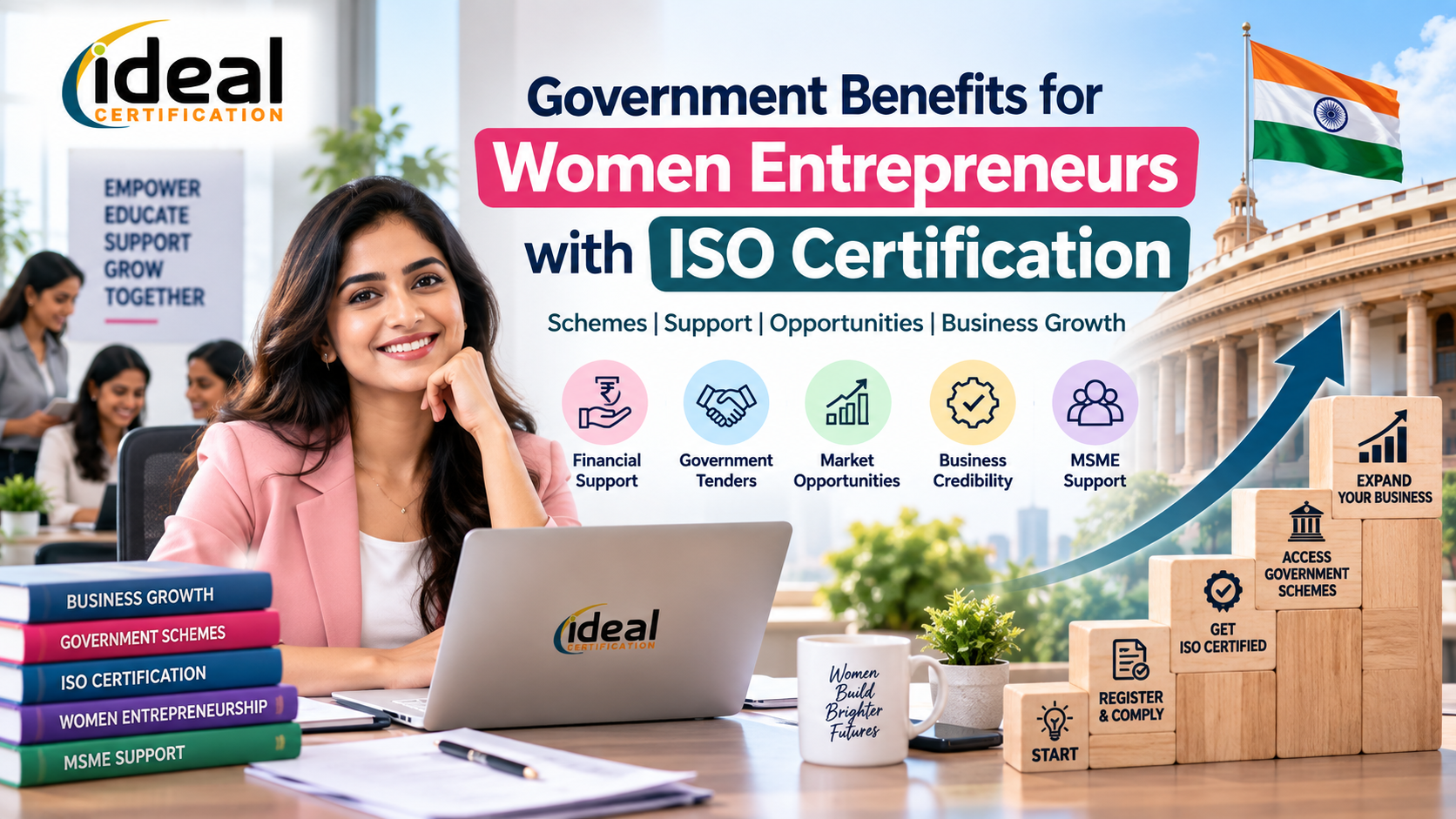
Government Benefits for Women Entrepreneurs with ISO Certification in India
11 Jul 2026
Women-owned businesses are playing an increasingly important role in India’s MSME, startup, manufacturing, services, food, healthcare, technology, retail, and export sectors. For many women entrepreneurs, the next stage of growth involves more than increasing sales—it means building a business that is trusted by customers, prepared for larger contracts, and capable of meeting formal quality and compliance expectations.
This is where ISO certification for women entrepreneurs in India can become strategically useful.
It is important to understand one point clearly: ISO certification does not automatically provide a government subsidy, loan, grant, or preferential treatment. Government schemes have their own eligibility criteria. However, an appropriate ISO management system can strengthen a business's quality processes, documentation, credibility, supplier readiness, and ability to meet specific customer, tender, vendor-registration, or contractual requirements.
Government programmes currently provide support to MSMEs through areas such as finance, market access, procurement, entrepreneurship development, technology and quality improvement. The Ministry of MSME lists initiatives including PMEGP, CGTMSE, Procurement & Marketing Support, Consortia & Tender Marketing, Technology Upgradation and Quality Certification, and Entrepreneurship & Skill Development programmes.
What Government Benefits Are Available for Women Entrepreneurs in India?
The benefits available to a woman-owned business depend on its legal structure, MSME status, sector, location, project type, and the specific government scheme.
Some important areas of government support include:
- Business financing and credit support
- Credit-linked assistance for eligible enterprises
- Market-development opportunities
- Government procurement and tender participation
- Entrepreneurship and skill-development programmes
- Technology and quality improvement
- Digital market access
- Mentoring and capacity building
- Support for formalisation and compliance
The Ministry of MSME's Yashasvini Initiative, for example, focuses on women entrepreneurs through formalisation, capacity building, mentorship and market linkage. Its support areas include financial access, market access, legal support and business compliance. The initiative also focuses on supporting the government's 3% procurement target from Women MSEs under the Public Procurement Policy.
This creates an important opportunity for women-owned MSMEs to build stronger business systems and become better prepared for institutional markets.
How Does ISO Certification Help Women-Owned Businesses?
ISO certification establishes that a business has implemented a management system against the requirements of a particular ISO standard and has undergone the applicable certification process.
For a women-owned business, the value can go beyond displaying an ISO logo.
A well-implemented management system can help the entrepreneur create:
- Consistent operating procedures
- Better quality controls
- Defined responsibilities
- Documented business processes
- Risk-management practices
- Customer complaint handling
- Corrective-action systems
- Supplier evaluation processes
- Improved record keeping
- Continual improvement practices
These systems can be particularly useful when a business moves from serving individual customers to working with corporate buyers, institutional customers, distributors, government departments, PSUs, exporters, or larger supply chains.
Ideal Certification provides end-to-end support including gap analysis, documentation, audit preparation, implementation guidance and certification through applicable certification bodies. Its ISO 9001 service specifically covers documentation, audit support and certification assistance for manufacturers, MSMEs, startups, exporters and service providers.
7 Key Benefits of ISO Certification for Women Entrepreneurs
1. Builds Professional Business Credibility
A growing women-owned enterprise may need to demonstrate its capability to customers, distributors, investors and business partners.
ISO certification can provide documented evidence that the organization has established a structured management system.
For example, ISO 9001:2015 certification focuses on quality management and can help an organization establish consistent processes, monitor performance, address customer requirements and pursue continual improvement.
This can be particularly valuable for women entrepreneurs competing with established businesses for B2B contracts.
2. Supports Government Tender and Vendor Requirements
Government contracts and corporate procurement often involve specific eligibility and technical requirements.
An ISO certificate does not guarantee that a business will qualify for or win a tender. However, when a tender, buyer, or vendor-registration process specifically asks for an ISO certification, having the relevant certificate can help the business satisfy that requirement.
The Ministry of MSME reports public-procurement activity involving women-owned MSEs, while its current procurement initiatives also focus on improving market access for MSEs.
For a women entrepreneur targeting institutional customers, it is therefore useful to examine tender documents carefully and determine whether ISO certification is actually required.
3. Strengthens Readiness for Government Procurement
Government procurement can create opportunities for eligible micro and small enterprises.
The MSME Ministry's procurement ecosystem includes initiatives designed to improve MSE participation in government purchasing and tender opportunities. The current MSME procurement dashboard reports procurement from women-owned enterprises as a separate category.
ISO certification can complement this effort by helping an organization demonstrate structured processes and quality controls.
However, businesses should not assume that ISO certification itself creates procurement preference. Eligibility depends on the applicable procurement policy, tender conditions and the enterprise's other qualifications.
4. Improves Quality and Operational Control
For many women entrepreneurs, business growth means managing more employees, suppliers, orders and customers.
Without documented processes, operational problems can increase as the organization expands.
ISO 9001 can help businesses establish a systematic approach to:
- Process control
- Customer requirements
- Supplier management
- Risk and opportunity assessment
- Non-conformity handling
- Corrective action
- Internal audits
- Performance monitoring
- Continual improvement
This makes ISO certification for women-owned MSMEs more than a marketing exercise. When properly implemented, it can become part of the organization's operating framework.
5. Helps Build Customer and Corporate Buyer Confidence
Large organizations often evaluate suppliers more carefully than individual customers.
A corporate buyer may want evidence of:
- Quality controls
- Documented processes
- Traceability
- Risk management
- Consistent service delivery
- Supplier controls
- Compliance practices
The exact requirements vary by industry and buyer.
An ISO management system can help a women-owned business demonstrate that it has moved from informal processes toward a structured and measurable operating model.
This can be especially relevant for manufacturers, IT companies, food businesses, healthcare organizations, logistics companies, exporters and professional service providers.
6. Supports Expansion Into New Markets
As a business grows, its customers may increasingly come from outside its original local market.
ISO certification can help strengthen the organization's professional profile when approaching:
- Corporate clients
- International customers
- Export partners
- Distributors
- Institutional buyers
- Large supply chains
- Vendor-registration programmes
Ideal Certification states that its ISO services support businesses across India and that applicable certificates can be used for tender, export and international business requirements.
The actual acceptance of a certificate should always be checked against the requirements of the buyer, tender or destination market.
Which ISO Certification Is Suitable for Women Entrepreneurs?
There is no single best ISO certification for women entrepreneurs. The appropriate standard depends on the business activity and the objective behind certification.
ISO 9001:2015 – Quality Management
Suitable for many:
- Manufacturers
- Traders
- Service providers
- Startups
- MSMEs
- Export businesses
- E-commerce businesses
- Professional service companies
ISO 9001 is often considered when a business wants to improve quality management, customer satisfaction and process consistency.
ISO 14001:2015 – Environmental Management
Relevant for organizations looking to systematically manage environmental aspects, resource use, waste and applicable environmental obligations.
It can be particularly relevant to manufacturing, construction, logistics, energy and other businesses with significant environmental impacts.
ISO 45001:2018 – Occupational Health & Safety
Useful for businesses that need a structured occupational health and safety management system, particularly in sectors where workplace risks are significant.
ISO 27001:2022 – Information Security
Relevant to:
- IT companies
- Software businesses
- SaaS companies
- Data-driven businesses
- Technology startups
- Organizations handling sensitive information
ISO 22000:2018 and HACCP – Food Safety
Food manufacturers, processors, restaurants, food-service businesses and other organizations within the food chain may consider food-safety management standards based on their activities and requirements.
ISO 13485:2016 – Medical Devices
Relevant to organizations involved in the medical-device sector where the standard applies.
Ideal Certification also lists services covering ISO 9001, ISO 14001, ISO 45001, ISO 27001, ISO 22000, ISO 13485, HACCP, GMP, CE and other management/certification services.
Can Women Entrepreneurs Get Government Subsidies for ISO Certification?
This is one of the most important questions.
ISO certification by itself does not automatically make a woman entrepreneur eligible for a government subsidy.
Government schemes have separate eligibility conditions, application procedures and documentation requirements.
For example, PMEGP is a credit-linked subsidy programme intended to support eligible new micro-enterprises in the non-farm sector. The current MSME Ministry page states that the maximum admissible project cost is ₹50 lakh for manufacturing and ₹20 lakh for business/service activities.
Similarly, other government programmes may provide credit, procurement, marketing, technology or entrepreneurship support.
Therefore, a business should evaluate:
- Whether it is registered as an eligible enterprise.
- Whether the entrepreneur meets the scheme's eligibility conditions.
- Whether the business activity qualifies.
- Whether the project meets financial and technical requirements.
- Whether ISO certification is required or simply beneficial.
- Whether the relevant tender or programme specifies a particular ISO standard.
This distinction prevents a common misconception: ISO certification can strengthen business readiness, but it should not be presented as a guaranteed government benefit.
Government Schemes and ISO Certification: How They Can Work Together
The relationship is better understood as a combination of government support + business formalisation + management-system development.
For example:
Government support
→ Financing / market access / procurement / entrepreneurship support
Business formalisation
→ Udyam registration / statutory registrations / documented business operations
Management system
→ ISO 9001 / ISO 14001 / ISO 27001 / ISO 45001 / sector-specific standard
Market readiness
→ Better documentation / supplier qualification / tender readiness / customer confidence
This approach can help women entrepreneurs build a business that is prepared for larger commercial opportunities rather than treating ISO certification as merely a certificate to display.
What Documents Are Generally Needed for ISO Certification?
The exact documentation depends on the standard, business scope and certification requirements.
For many ISO applications, businesses may be asked for information such as:
- Business registration or incorporation proof
- Udyam/MSME registration, where applicable
- Address proof
- Business activity and scope
- Employee information
- Products or services information
- Purchase bills or invoices, where applicable
- Existing management-system documents
- Completed certification application
Ideal Certification's published ISO guidance also identifies registration proof, address proof, purchase bills/invoices and application information among commonly required documents.
The important point is that documentation should reflect the actual operations of the business rather than being copied templates with no connection to how the company works.
How to Get ISO Certification as a Woman Entrepreneur in India
A professional ISO certification process generally involves the following stages:
Step 1: Identify the Correct ISO Standard
Choose the standard according to your industry, customer requirements, risks and business objectives.
Step 2: Define the Certification Scope
Clearly establish which products, services, locations and activities are covered.
Step 3: Gap Analysis
Assess existing processes against the applicable ISO requirements.
Step 4: Documentation
Develop or update relevant policies, procedures, SOPs, records and other management-system documentation.
Step 5: Implementation
The organization puts the management system into actual practice.
Step 6: Internal Audit and Corrective Action
Internal review helps identify gaps and areas requiring corrective action before the certification audit.
Step 7: Certification Audit
An applicable third-party certification body evaluates conformity with the relevant standard.
Step 8: Certification
After successful completion of the applicable certification process and closure of required findings, the certificate is issued.
Ideal Certification describes its service as end-to-end support covering gap analysis, documentation, implementation guidance, audit preparation and certification assistance.
Why Choose Ideal Certification for Women-Owned Businesses?
Women entrepreneurs often need a certification partner that understands both business practicality and compliance requirements.
Ideal Certification provides ISO certification services across India with support for startups, MSMEs, manufacturers, exporters and service organizations. Its published service information highlights:
- 100% online and paperless process
- ISO documentation assistance
- Gap analysis
- Audit preparation
- Implementation guidance
- Certification support
- Transparent pricing
- Support across multiple ISO standards
- Tender and vendor-registration support
- Services for businesses across India
The company states that it was established in 2014 and has supported 5,000+ businesses across India.
For a women-owned business, the right approach is to first understand the commercial objective—such as improving quality, meeting a buyer requirement, preparing for a tender, entering a new market or strengthening internal processes—and then select the certification that actually supports that objective.
Frequently Asked Questions
1. What government benefits are available for women entrepreneurs with ISO certification?
Women entrepreneurs may be eligible for different government programmes covering areas such as finance, credit, procurement, market access, entrepreneurship development and capacity building. ISO certification does not automatically create eligibility, but it can help a business meet specific quality, vendor or tender requirements where ISO certification is requested.
2. Is ISO certification mandatory for women-owned businesses in India?
ISO certification is not generally mandatory simply because a business is owned by a woman. However, a particular government tender, corporate buyer, industry requirement or contract may specify an ISO certification as an eligibility or technical requirement.
3. Which ISO certification is best for women entrepreneurs?
There is no universal certification that is best for every women-owned business. ISO 9001:2015 is broadly applicable to quality management, while ISO 14001, ISO 27001, ISO 45001, ISO 22000, ISO 13485 and other standards address specific business needs and industries.
4. Can ISO certification help women entrepreneurs get government tenders?
It can help where the relevant tender specifically requires or awards consideration for the applicable certification. However, ISO certification does not guarantee tender eligibility, selection or contract award. Businesses should review every tender's eligibility and technical requirements separately.
5. How much does ISO certification cost in India?
There is no single fixed price. Cost depends on the ISO standard, organization size, scope, number of employees or locations, industry complexity and certification requirements. Ideal Certification provides customized quotations based on the business and certification scope.
Conclusion
For women entrepreneurs in India, business growth increasingly depends on credibility, process maturity, compliance, market access and the ability to serve demanding customers.
Government programmes can provide opportunities through finance, procurement, entrepreneurship development, market access and other forms of MSME support. At the same time, ISO certification can help a women-owned business establish documented processes, improve quality management, strengthen customer confidence and prepare for applicable tender, vendor and corporate requirements.
The key is to view ISO certification for women entrepreneurs as part of a broader business-development strategy—not as a guaranteed government subsidy or shortcut to contracts.
If you are planning ISO certification for a women-owned MSME, startup, manufacturing unit, IT company, food business, healthcare organization, exporter or service business, the first step is to identify the correct ISO standard and certification scope.
Get professional guidance from Ideal Certification:
Ideal Certification
Phone / WhatsApp: +91-8126500772
Email: info@idealcertification.com
Address: Ground Floor, Shop No.11, EL - Commercia, Pr 7 Road, Near Maya Garden City, Gate No.3, Zirakpur, Punjab - 140603, India