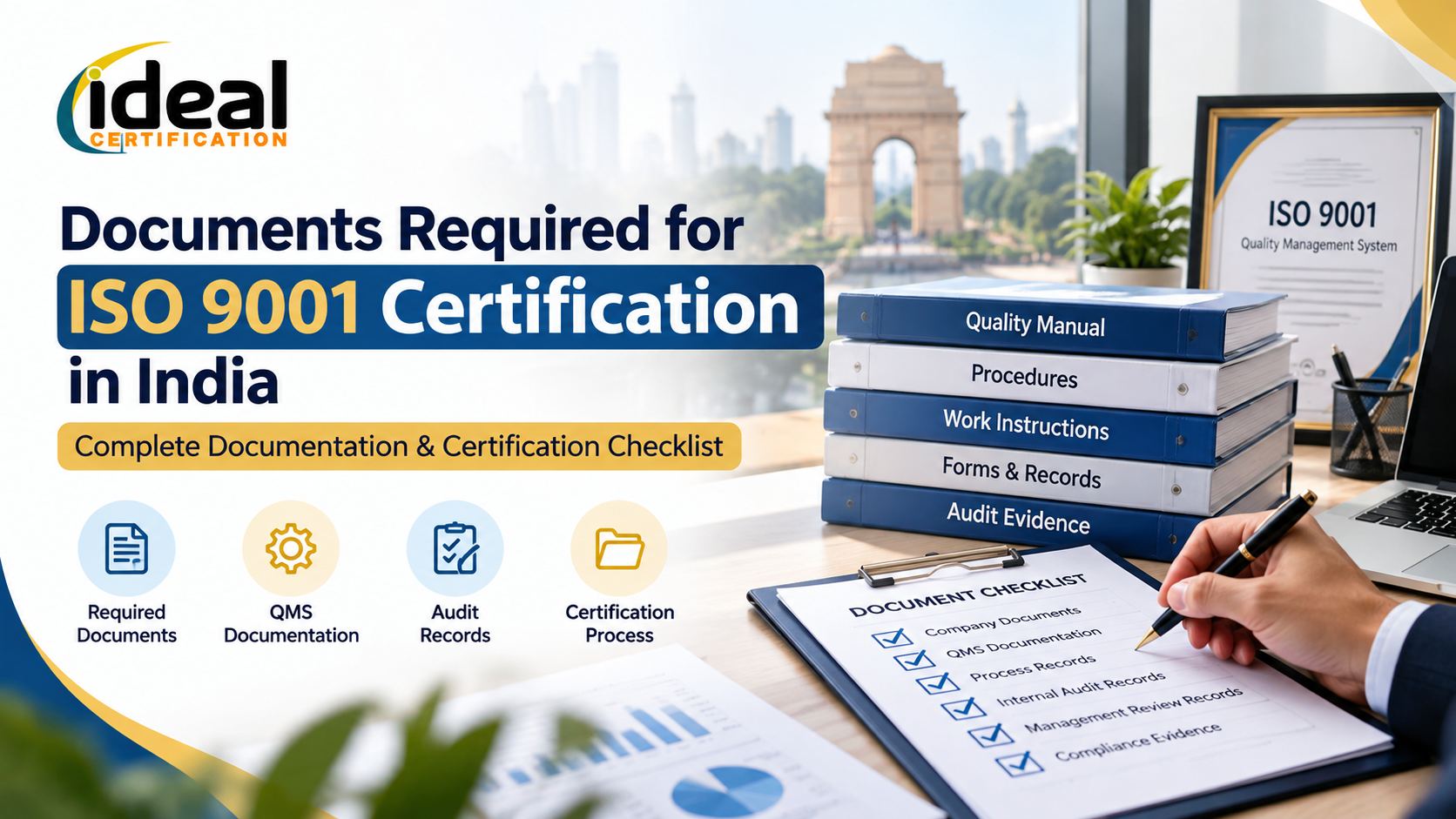
Documents Required for ISO 9001 Certification in India
14 Aug 2026
What Documents Are Required for ISO 9001 Certification in India?
If your business is planning to obtain ISO 9001 certification, preparing the right documentation is an important part of the process. The documents required for ISO 9001 certification in India generally include business information, Quality Management System (QMS) documentation, operational procedures, records, and evidence that the system is being implemented effectively.
ISO 9001 focuses on establishing, implementing, maintaining, and continually improving a Quality Management System. The documentation needed depends on factors such as the organization's size, activities, processes, products or services, risks, and complexity.
A common mistake is assuming that every company needs exactly the same set of documents. In practice, the QMS should be appropriate to the organization and should provide sufficient evidence that its processes are controlled and effective.
Quick answer: The ISO 9001 certification document checklist may include company registration proof, address details, scope of the QMS, quality policy, quality objectives, process documentation, SOPs, work instructions, risk-related information, internal audit records, management review records, corrective-action records, training records, supplier records, and other evidence relevant to the organization's operations.
Basic Documents Required for ISO 9001 Certification
Before the certification process begins, a certification provider may require basic information about the organization.
Common documents include:
- Company registration or incorporation certificate
- Business license, where applicable
- Organization address proof
- PAN or other applicable business identification details
- GST registration, where applicable
- Company profile
- Details of products or services
- Employee or organizational information
- Contact details of the authorized representative
- Proposed ISO 9001 certification scope
- Completed certification application form
The exact requirements can vary according to the certification arrangement and the organization's legal structure.
ISO 9001 QMS Documentation Requirements
The most important part of the ISO 9001 documentation requirements relates to the organization's Quality Management System.
Depending on the business, this can include:
1. Quality Policy
The quality policy explains the organization's overall commitment to quality, customer satisfaction, applicable requirements, and continual improvement.
It should be appropriate to the organization's purpose and provide direction for establishing quality objectives.
2. Quality Objectives
Quality objectives establish measurable or otherwise assessable goals for improving business and process performance.
Examples may include:
- Reducing customer complaints
- Improving delivery performance
- Reducing product defects
- Increasing customer satisfaction
- Improving process efficiency
3. QMS Scope
The organization should clearly define what products, services, locations, and processes are covered by its Quality Management System.
A well-defined scope helps auditors and stakeholders understand the boundaries of the QMS.
4. Process Documentation
Businesses should identify and manage the processes necessary for their operations.
Depending on the organization, documentation may cover:
- Sales
- Purchasing
- Production
- Service delivery
- Customer support
- Quality control
- Human resources
- Supplier management
- Inspection and testing
- Design and development
Not every organization needs the same level of formal documentation. The documentation should support effective process operation and control.
ISO 9001 Records and Evidence
Documentation alone does not establish an effective QMS. During an ISO 9001 audit, the organization may need to demonstrate evidence that its processes are actually being implemented.
Examples of ISO 9001 records can include:
- Internal audit records
- Management review records
- Training and competence records
- Customer complaint records
- Customer satisfaction information
- Corrective action records
- Nonconformity records
- Supplier evaluation records
- Inspection and testing records
- Equipment maintenance records
- Calibration records, where applicable
- Monitoring and measurement results
- Product or service delivery records
These records help demonstrate that planned activities are being carried out and that the organization evaluates and improves its processes.
Is a Quality Manual Mandatory for ISO 9001?
A quality manual is commonly associated with ISO 9001 documentation, but organizations should not assume that a traditional standalone quality manual is universally mandatory.
ISO 9001:2015 introduced greater flexibility in how organizations maintain documented information. The appropriate documentation depends on the organization's size, activities, process complexity, competence, and other circumstances.
Therefore, instead of creating documents simply to increase paperwork, businesses should develop documentation that genuinely supports their QMS and provides objective evidence of effective implementation.
ISO 9001 Certification Process and Documents
The ISO 9001 certification process in India generally involves several stages.
Step 1: Understand the Certification Scope
Determine which products, services, locations, and processes will be covered.
Step 2: Conduct a Gap Assessment
Review existing processes and documentation against the applicable ISO 9001 requirements.
Step 3: Develop QMS Documentation
Prepare the necessary policies, objectives, procedures, process information, forms, and records based on the organization's actual operations.
Step 4: Implement the QMS
Employees should follow the established processes and maintain appropriate records.
Step 5: Conduct an Internal Audit
An internal audit helps identify nonconformities, weaknesses, and opportunities for improvement before the certification audit.
Step 6: Management Review
Management evaluates QMS performance, objectives, risks, audit results, customer feedback, and improvement opportunities.
Step 7: Certification Audit
The certification body evaluates the organization's QMS and its implementation against the applicable requirements.
ISO 9001 Documents Checklist for Small Businesses
Small businesses and startups often worry that ISO certification requires excessive paperwork. That is not necessarily the case.
A practical ISO 9001 documentation checklist may include:
- Company and registration information
- QMS scope
- Quality policy
- Quality objectives
- Process information
- Relevant SOPs and work instructions
- Risk and opportunity information
- Competence and training records
- Supplier evaluation records
- Customer feedback and complaint records
- Internal audit records
- Management review records
- Corrective action records
- Operational records relevant to the business
The exact list should be developed according to the organization's activities rather than copied from another company.
ISO 9001 Certification Documents for MSMEs
For MSMEs, the documentation should be practical and proportionate to the size and complexity of the business.
A manufacturing company may require detailed production, inspection, supplier, maintenance, and calibration records. A service company may focus more heavily on customer requirements, service delivery, competence, complaints, and performance monitoring.
This is why a QMS documentation approach for small businesses should be customized rather than based on a generic template.
Why Proper Documentation Matters
Well-maintained QMS documentation can help an organization:
- Standardize important business processes
- Clarify responsibilities
- Improve consistency
- Demonstrate compliance
- Track performance
- Identify problems
- Support internal audits
- Provide evidence during certification audits
- Improve customer satisfaction
- Support continual improvement
The objective should be an effective management system—not simply a collection of documents.
How Ideal Certification Can Help
Preparing documents required for ISO 9001 certification in India can be easier when the documentation is aligned with the organization's real processes.
Ideal Certification provides ISO certification support for businesses across India, including assistance with QMS documentation, implementation, audit preparation, and certification-related requirements.
Whether you operate a manufacturing company, service organization, startup, MSME, exporter, software business, or another type of organization, the documentation can be structured according to your business activities and certification scope.
For ISO 9001 certification assistance, contact Ideal Certification:
Phone: +91-8126500772
Email: info@idealcertification.com
Address: Ground Floor, Shop No.11, EL - Commercia, Pr 7 Road, Near Maya Garden City, Gate No.3, Zirakpur, Punjab - 140603
Conclusion
Understanding the documents required for ISO 9001 certification in India is an important first step toward establishing a structured Quality Management System.
The required documentation may include company information, QMS scope, quality policy, quality objectives, process documentation, procedures, work instructions, operational records, internal audit evidence, management review records, corrective-action records, and other documented information relevant to the organization.
However, there is no universal checklist that should be copied by every business. The right documentation depends on the organization's size, activities, processes, products or services, risks, and operational complexity.
If you are planning ISO 9001 certification and need help understanding your documentation requirements, contact Ideal Certification for professional guidance and certification support across India.
Frequently Asked Questions
1. What documents are required for ISO 9001 certification in India?
Common documents include company registration details, address proof, QMS scope, quality policy, quality objectives, process documentation, relevant procedures, operational records, internal audit records, management review records, corrective-action records, and other evidence applicable to the organization's processes.
2. What are the mandatory documents for ISO 9001?
ISO 9001 does not mean that every organization must maintain an identical set of documents. Required documented information depends on the applicable requirements and what is necessary for the effective operation and control of the organization's QMS.
3. How many documents are required for ISO 9001 certification?
There is no universal fixed number of ISO 9001 documents. The amount of documentation depends on the organization's size, activities, process complexity, risks, products or services, and competence.
4. Is a quality manual mandatory for ISO 9001 certification?
A traditional standalone quality manual should not automatically be treated as mandatory. ISO 9001 allows organizations flexibility in determining appropriate documented information for their Quality Management System.
5. What records are checked during an ISO 9001 audit?
Depending on the organization's scope and processes, auditors may review records relating to internal audits, management reviews, customer feedback, complaints, corrective actions, competence and training, suppliers, monitoring and measurement, and operational activities.